A Look At Epilepsy, Speech Delay, and Autism:
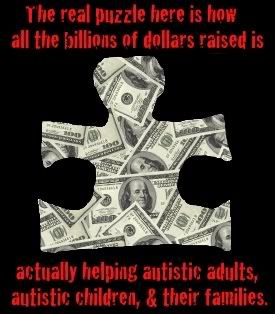
THIS IS ALL HYPOTHETICAL FOOD FOR THOUGHT. Jenny proclaims herself as the "Autism Mom" who speaks for all other "autism moms" and the "autism community." But, what if her son never really had autism? It's a fair question to ask, as Jenny herself has said in recent interviews: neurologists who see him now for epilepsy say he never had autism. What if, instead, he had a culmination of other disorders, that appeared similar to autism? Suppose a physician gave the "autism" diagnosis without really absorbing this child's medical history? Then what? Can anyone really consider Jenny an "autism mom" or as someone to "represent" anyone in the autism community? She has made quite a bit of money off of autism and out of promoting "recovery" for autistic children. Perhaps that is why she dismisses the neurologists who now tell her that her son was never autistic?
Okay, let's go back and review some medical history (as we know it, by Jenny).
We know that Jenny's son has epilepsy, he had at least 2 very serious seizures (to which I do absolutely sympathize with Jenny, I have seen my daughter turn blue, foam bubbling out of her mouth--those seizures are horrible to witness and scary as hell). Seizures, especially one that causes a child to go into cardiac arrest can cause neurological damage. Perhaps, that damage resulted in some "autistic-like" symptoms? It is very feasible that the epilepsy led to speech delays. Look at this study (that is very similar to the story of Jenny's son):
A 2-year-old boy presented with an early form of benign partial epilepsy with centro-temporal spikes (BCERS) and a severe speech delay. Family video analysis revealed an early regression of babbling and stagnation since the age of 12 months. Complete recovery occurred with anti-epileptic treatment. The deficit corresponded to a transient speech apraxia attributed to an epileptic disconnection of networks coordinating speech articulation. This observation is, to the best of our knowledge, the first demonstration that delayed emergence of language can be due to an epileptic dysfunction interfering with prelinguistic skills and therefore mimicking a developmental delay.
Bold for emphasis by me, specifically the regression, stagnation, and "recovery" following proper seizure treatment. Interesting when we know that Jenny's son is/was treated for seizures (have not been able to confirm whether he is still on a seizure treatment). Also important to note, not every seizure medication will work for every patient with seizures. It is often trial and error until the correct medication and dose is found. Some patients have to try several drugs before properly controlling, and therefore treating, their epilepsy.
Jenny's son had adverse reactions to at least one seizure medication, so who knows how long it took for the anti-epileptic treatment to begin working (and when his "recovery" began). It's also unclear if her son still takes seizure medication. On CNN, she did say that "
seizures, we still worry about" Now any parent with a child who has seizures, especially those as severe as Evan's, understands that their child requires epilepsy medicine (typically for at least 1-4 years following the last seizure, depending on type of seizure(s) and patient's history). So, certainly, her son is still on medication--
if she, and the neurologists, still worry about seizures (again, especially with a history of such severe episodes).
I've seen many statements about Evan being
misdiagnosed with epilepsy. As if, the autism itself explained the seizures, and erased an epilepsy diagnosis. It is true that a percentage (
around 30%) of autistic people have seizures, but seizures are not part of the criteria for autism. My daughter has a seizure disorder and autism, adding "autism" to her medical records did not make her seizures an unnecessary diagnosis. I wonder why it seems Jenny is quick to say that the epilepsy was a mis-diagnosis, but the autism was an accurate one?
Moving on, epilepsy occurring at the same time as speech delay in young children is not that rare. And, it's well accepted that young children with speech delays can present similarly to children with autism. There may be
some red flags in those children. Physicians need to be very skilled in diagnosing autism, and also in pediatric epilepsy and speech delays, in order to help differentiate between the them (and understand what a combination of any of those might present as). There is
a definite link between some types of epilepsy and developmental delays:
Certain types of epilepsy can be linked with learning, behavioural and speech and language difficulties. This is increasingly recognised and the risks are greater if epilepsy occurs before 2 years of age. Parkinson found that from a small study of children referred for assessment of their epilepsy, 40% had undiagnosed language impairment of varying degrees of severity.
Epilepsy can cause temporary loss of function in one or more parts of the brain. If these parts are involved with understanding, organisation and communication processing difficulties in using language can result. These difficulties can be severe, causing general delay in language development or a disordered pattern of language abilities.
The following epilepsy syndromes have associated language difficulties. They include:
• Landau Kleffner Syndrome
• ESES or Tassinari's Syndrome - now called CSWS (Continuous Spike Waves of Slow Sleep)
• Lennox-Gastaut Syndrome
• Temporal Lobe Epilepsy
Sometimes the disability can be extremely subtle - such as high level language impairment disorder. They may have pragmatic difficulties and, therefore, will not have a clear understanding of language use. They can appear socially inept and can misread others' intentions. In these cases the child may exhibit bizarre or socially unacceptable behaviours or the child's language may appear to be 'odd' in an inconsistent way. They may have poor turn taking skills, excessive or restricted topic maintenance, and poor skills in greeting, questioning, seeking the attention of others, describing or commenting.
Some children may have episodes of slurred or disfluent speech. These episodes can occur suddenly and be unconnected with stress or other obvious 'trigger' factors. They can be caused by changes in medication and/or as a result of epileptogenic activity i.e. electrical activity in the brain which does not necessarily manifest itself as an obvious epileptic attack.
It appears there's more than just a little evidence out there to suggest a child with epilepsy can also have developmental delays (specifically in areas of speech). It's clear that children with developmental delays can sometimes have "autistic-like" symptoms, and can also have sensory integration issues (which can lead to stimming and restrictive or repetitive movements, play, etc.). I would dare to say that there are more than a few children out there who were at one point diagnosed with autism, when in fact, they had epilepsy along with developmental delays.
Lastly,
Dr. Fernando Miranda pushes for more EEG's and MRI's to be a part of the autism diagnosis process. He has apparently found children at one time diagnosed with autism to have various epilepsy disorders (and more than likely, not autism). I for one am thankful that my daughter has had an MRI and several EEG's, the information gained can sometimes be invaluable--both to rule out or rule in various conditions.
*Disclaimer: I do not have any personal knowledge of Jenny McCarthy or her son's medical history, other than that made available to the public (via media outlets, et al). These are simply questions I feel worth raising, and ideas worth investigating.