Having an autistic child is not the end of the world--far from it. It is my hope that through this blog, at least a handful of people will get to understand that. My child is amazing, she brings us tremendous joy. We have good days & bad days, but we CHOOSE to focus on the good. Our belief is that by loving our daughter, giving her the most comfortable environment we can, and by most of all accepting her differences, she will continue to blossom--in her OWN way.

Showing posts with label Advocacy. Show all posts

7/6/08

Attention Autistics & Fellow Family Members: ABC Wants To Hear From Us Again

I'm not entirely sure what this presentation will turn out like, what the focus will be, and so on. I thought I'd send this along though, hopefully we can ensure that our voices can be heard (once again).


ABC News Seeks Submissions for iCaught: OnCall+ Autism
Thursday, July 3, 2008
By: Carin Yavorcik

Share your stories via video

ABC News is presenting an opportunity for you to share your personal experiences as part of a special hour on Good Morning America Now: "OnCall+ Autism." You can also send a question about autism that may be answered by a top medical expert in the field.

ABC News is looking for video submissions on the following topics:
1) Your thoughts on living with autism or with loved ones with autism
2) Any questions you might have on autism to be answered by our medical
experts

Most digital cameras now have a video function that allows the user to record 30-second to 1-minute videos. Once recorded, you can upload the video to your computer the same way you'd view digital snapshots. ABC News is specifically requesting 15- to 45-second videos.

How to submit:

1) Via cell phone:
Record a 15- to 45-second clip and email it to: icaught@abcnews.go.com

2) Via the web
Click on the red "RESPOND NOW" button

Videos submitted by the end of July may appear on ABC News NOW!

6/10/08

End Abuse of Children in Residential Programs: ACT TODAY!

I received this from ASAN and wanted to spread the word. Please call your Representative and urge them to support and vote yes on H.R. 5876!

Grassroots Action Needed for Approaching Vote

June 10, 2008-After swift approval by the House Education and Labor Committee
on May 22, The "Stop Child Abuse in Residential Programs for Teens Act of 2008"
(H.R. 5876) appears headed to the House floor for a vote next week.

The bill is a welcomed response to thousands of allegations of child abuse and
neglect at private residential programs (therapeutic boarding schools, wilderness
camps, boot camps and behavior modification facilities) for teens with emotional,
behavioral or mental health needs, reported by the Governmental Accountability
Office
(GAO).

Although some parents find such programs helpful, protections are needed
because too many children are being abused and nobody is watching. H. R. 5876
would make available information to help parents make informed choices about
their children's care in these placements.

H.R. 5876 was introduced on April 23 and is sponsored by committee chairman
George Miller (D-CA) and Representative Carolyn McCarthy (D-NY). It would:

  • Keep teens safe with new national standards for private residential programs.
  • Prevent deceptive marketing by requiring disclosure to parents of qualifications,
    roles and responsibilities of current staff and of substantiated reports of child
    abuse or violations of health and safety laws. Programs would also have to
    provide a link to or web address for information on all private residential programs
    kept by the U.S. Department of Health and Human Services (HHS).
  • Hold teen residential programs accountable for violating the law by requiring
    HHS to conduct unannounced site inspections at least every two years.
    Civil penalties up to $50,000 would be levied for every violation of the law and
    parents would have a federal right to sue program operators that violate the
    national standards.
  • Ask states to step in to protect teens in residential programs by providing grants
    to states that develop their own standards that are at least as strong as the
    national standards and inspect the programs in their state at least every two years.

Under Chairman Miller's leadership, this issue has garnered much-needed
attention. The Committee's website has links to testimony from an April 24
hearing, where the GAO and other experts testified and presented a follow-up
GAO report
.

Please Act Today!

Urge your Representative to support H.R. 5876 today and to vote yes when
the bill is considered on the House floor.

  • Call the Capitol switchboard at 202-224-3121 and ask for your Representative's
    office. You can also call your Representative's direct lines, available on his
    or her website through www.thomas.gov/

Now is the time to end abuse and neglect in private residential programs that are
intended to help teens with behavioral, emotional and mental health problems.

5/24/08

"I'm Not Special"

Those are the words that Alex Barton has come to say repeatedly to himself. He screams in the car when his mother drops his sister off at school. He's refusing to eat and unable to sleep in his own room. Alex was recently kicked out of his school, by his classmates--after his teacher took a vote on it. Alex is thought to have Autism (currently being evaluated for Asperger's). He is also just five years old, in kindergarten at Morningside Elementary in Port St. Lucie, Florida.

Remember Kindergarten? That time of our lives when we are supposed to be taught to be good citizens, to learn social skills, to learn how to "get along," and how to obey the school rules. We're also supposed to have fun, play, and make new friends. Kindergarten is supposed to be the foundation upon which our next 12+ years of education will rest upon.

And yet, in Alex's classroom, the lessons being taught by Wendy Portillo appear to be ones of prejudice, intolerance, and outright cruelty. Alex's peers learned from their teacher that if someone is different, and you have a hard time understanding their habits, actions, delays, etc., then you simply dismiss them. Get rid of them. Kick them out. Take a vote, and out the classroom they go.

And, before you do, you might as well tell that person what you think of them. Five year old obscenities like "disgusting" and "annoying." This is brutality, no doubt. Melissa Barton (Alex's mother) reports that Wendy Portillo confirmed that this indeed happened. If that is the case, this teacher is cruel and inhuman, a person who has no business being in the education sector. She is teaching innocent, naive five year olds a lesson of hatred. A lesson that these children will not soon forget. We can only hope that these kindergarteners' parents have enough sense (and compassion) to explain to their children how wrong this is. It's far better to teach their children tolerance, acceptance, and understanding, and it's my wish they realize that.

If these reports have been confirmed, I see no reason why this teacher still has a job. She should have immediately been fired, no questions asked. One can't help but wonder--if this child wasn't autistic, what steps would the district would have taken? Had this been any other child in that classroom, all hell would have broke lose. There would have been protests, and no doubt, due to massive political pressure, this teacher would have received her walking papers STAT.

We've all seen how autism continues to be portrayed on television--as children who are violent, angry, withdrawn, and out of control, who were "kidnapped" or "lost their soul." The parents desperate and depressed, their lives "spiraling out of control." So, when the public hears that this child has autism, and was having "behavioral issues," most say "well, I can understand why you wouldn't want a kid like that in the classroom." They presume to know Alex all because of what they've seen or heard, these biased reports in the media. Society doesn't want to understand (let alone accept) autism or autistics--at any age. They're being constantly fed these ideas about recovery or a cure, not ever about the dignity or acceptance of autistic individuals. The message that those lives are not worthy of our respect or our time is what the public hears.

So again, when an autistic child is kicked out of class, they don't much care how or why it was done. They think nothing of the ramifications, not only on the autistic child, but also of the other children in that classroom. We are living in a culture of un-acceptance. We all must fit into the public's cookie-cutter mold, or we are just not good enough to be an equal member. Our society likes to preach a lot about being diverse, and about supporting those with disabilities. Yet, when it comes down to it, in the real day to day stuff, society would rather look the other way.

When people ask me why I cringe at a celebrity bragging about her "recovered" child or a politician working to "prevent and cure anything along the Autism Spectrum" or a grandmother declaring that "Autism knocked on the wrong door," I don't need to look far for my reasons. The case of Alex Barton clearly shows us that this propaganda reaches far and wide, not only into our homes, but even into our schools and churches. I want the Barton family to know that they have my full support, along with many others. I was grateful to read this, and learn that Alex's mother, Melissa Barton is a very strong woman, who will not let this slide:

“He has many of the symptoms of Aspergers” says his mother. “The teacher knew that he was under evaluation even having a part-time assistant just for Alex, and she decided that the best way to handle him would be through humiliation from his peers. I cannot imagine how he must have felt as his teacher encouraged the other students to bully Alex by telling him he is disgusting and they do not like him among other things. This is abuse and discrimination among other things; I will not soon let this go” says Melissa Barton. “The moment he needed me the most, I was at work. I do not know if he will ever trust teachers again, I do not know if I will ever trust the Port St Lucie School District again. I know it will be a while before I can convince my little boy that learning is fun. I am deeply sorrowed by the pain my child suffered at the hands of his Port St Lucie school teacher.”

Mrs.. Barton went on to say, “This is a sad day for parents of disabled children across the USA. I am now seeking the help of a physiatrist for my son as he refuses to eat, sleep in his own room and other problems that arrived directly after the abuse."


Make your voice heard, tell the Port St. Lucie school district that this type of discrimination and hatred will not be tolerated.

CONTACT INFO:

Morningside Elementary School Principal:
Mrs. Marcia Cully

cullym@stlucie.k12.fl.us
(772) 337-6730

St. Lucie County Schools Superintendent:
Michael J. Lannon
4204 Okeechobee Road
Ft. Pierce, FL 34947-5414
Phone: 772/429-3925
FAX: 772/429-3916
lannonm@stlucie.k12.fl.us

St. Lucie County School Board Chair:
Carol Hilson
772-519-0397
hilsonc@stlucie.k12.fl.us

Vice Chair:
Judith Miller
772-528-4545
millerj@stlucie.k12.fl.us


The Autistic Self Advocacy Network is asking all those who write to express their outrage to cc: info@autisticadvocacy.org so that ASAN can keep track of the strength and sources of the response. They also advise us to be mindful that abusive messages hurt our cause--please be respectful in your comments.


A special thanks to Bev at Asperger Square 8 for bringing this to my attention.
Others who have blogged on this:

ballastexistenz
Whose Planet Is It Anyway?
Whitterer on Autism
Maternal Instincts
The Joy of Autism
LeftBrain/RightBrain
Action For Autism
Along the Spectrum

5/1/08

On Disablism

Blogging Against Disablism Day
Disablism is something is something new to me. Actually saying that now sounds ridiculous. It is true, I've come to realize, that until disability touches your life, most remain completely unaware of it (and yet many are guilty of it). As a parent of a disabled child, I'm slowly learning and seeing it in the world. I see it at times when other parents look at my child, I see it when some "professionals" give their opinion of her, and I even see it (although they have no clue of it) in the eyes of other kids on the playground. I am very aware that, unfortunately, this is only the beginning of my experiences with disablism. I hear from other parents who deal with it in their lives, with their older disabled children. I hear about it from disabled adults who face it on a daily basis. For those who feel disablism doesn't exist, you are sorely mistaken.


"DON'T STARE!!!"

That is what so many parents teach their children. Children are naturally curious about anyone who is different from them. Even a small infant may seem especially interested in seeing someone with glasses or with a different hair color, anything that is unlike their own parents. It is natural for a child to want to investigate. The first time they see a person in a wheelchair, for example, they are most likely thinking "wow, what is that cool chair with wheels?" Whether it is a walker, a guide dog, a wheelchair, someone flapping their hands--it's all curious to a child. So, they stare and observe. Upon noticing this, well-intentioned parents say those two words, in that tone, "DON'T STARE!!"

Most parents, having been raised with that same mindset, don't bother to explain differences or disabilities. They prefer to simply pull their child along and move on. Such a shame. A valuable life-lesson, lost. This message of don't stare, don't look, don't connect with "people like that" continues. I think often it's "innocent ignorance" on the part of parents, and how they too were raised. They're are afraid of the differences they see between themselves and a disabled person (differences are generally not embraced by society). They fear that if they ask a disabled person questions about their disability, that person will be offended. If we never open up a discussion, how will we ever understand one another? People sometimes seem awkward when my husband and I openly speak about autism, or even seizures and feeding tubes. It's not expected, we're not supposed to be open and honest about that sort of thing. This is not supposed to be dinner conversation. Except, it is. It is our life, and we want to educate you--we want to change your perception.

People have been told it's rude and improper to look, so how can they ever approach a disabled person? Trust me, there's nothing rude or improper to say "hello" to a disabled person, just as you would say "hello" to anyone else. Things like "how are you?" or "wild weather we're having" or "this line is ridiculous" and so on, will not offend a disabled person. I assure you. Granted, depending on the disability, a response may not be possible. But, have you lost anything by not even making the attempt, and by treating your fellow human being as just that--a fellow human being?

I was raised this same way. I do not fault my parents, they simply didn't know any better. They thought what they were doing was right. In middle school, I had major back surgery. I wore a cast that began just under my armpits, down my torso, and down one leg to the knee. After 6 weeks, the cast was replaced by a brace of the same size. About 2 months after that, the leg part of the brace came off. It was a months before I was without a brace. Following surgery, I slept in a hospital bed in our dining room, it had a trapeze on it so I could get myself on and off the bed. I had a commode that had to be kept in the laundry room. Our house was not friendly to me, the doorways and bathrooms were too small, my room was upstairs, getting outside required taking 4-5 steps to the front or back yards. My mother had to bathe me. I had a walker and a wheelchair. I remember being ashamed of it all--the cast, the commode, the walker. Part of it was just normal adolescent stuff. I wanted to be healthy, and to just be doing all the things my friends were doing. The other part, was that I felt I had lost my identity. People wouldn't see me--they'd see the cast (or brace), the walker, or the wheelchair. They would see what was wrong with me.

I learned many valuable lessons from that experience. I valued being able to move freely, like I never would have been capable of before my surgery, and will never lose sight of that. I valued privacy and independence, more than any of my friends could imagine. I valued my family even more, for all the support they gave me. I learned how to roll with life's punches, and make the best of it. I learned discipline, from grueling PT sessions. It took years for me to understand the emotions of that experience. I was too young to really understand it all--why I felt the way I did. As I grew up, I realized what I associated with the wheelchair, the special bed, etc. I saw it as weakness. I felt damaged. It took many years for my self-esteem to recover. Why did I feel those things?

Part of it was just my personality. I am stubborn, and I have a lot of pride. This was a challenge, one that I had little control over. I had to learn patience, and in the middle school years, let's face it--that's a tall order. The other part was, back again, to those early lessons and views on disabilities. I was the one I didn't want anyone to stare at. I didn't have a single friend come visit me--that was my choice. I shut myself in. I didn't want my friends to see the medical equipment, to see me in this big, bulky cast. I didn't want them to stare. It took a while for me to realize I was still the same kid. I still loved watching videos, playing games, and having fun. The cast or the wheelchair or any other equipment didn't change who I was on the inside.

It took that experience for me to realize that neither an ability nor a disability doesn't change who we are at the core. We're all human, we all have our likes and dislikes, we are all far more similar than we often think. It's sad to think that it was only being placed in that situation that changed me. From that moment on, I always felt a silent kinship to the disabled people I would pass on the street. I no longer stared at their equipment, at their differences. I saw a person.

I suppose my that was only part one of this lesson for me. I am now raising a beautiful, amazing, disabled child. As a parent of two children, one disabled, one not, I feel a two-fold responsibility (when it comes to disablism). My first, is to make sure my youngest child is respected, that she has the same rights as any other human being, and that she is appreciated for who she is.

For my eldest, it is to make sure I never say "DON'T STARE!" and end any communication about disability with that. I also make it my job that she learns to look past a disability. She has been "exposed" to more disabled kids than her peers, I would bet. From hospital visits, to doctors' appointments, to coming to some therapy sessions with us, she has seen many different disabled kids. I tell her that it's not nice to stare at someone, jut because they are different. Would she like it if in this world, people with blue eyes were considered "not normal" and so people often didn't talk to blue-eyed people like her, and most just stared? How would that make her feel? We are all different, I explain. Just like your sister's feeding tube, someone else may need a walker, or equipment to help them breathe, etc. That doesn't change who they are--they are just like you and I. Like your sister, they may have more challenges. But, it doesn't mean we can't be friends with them. And it certainly doesn't mean we can't be friendly toward them. You can say "hi" or wave, and you can look at a disabled child just like you would any other kid, but don't just stare, as that's rude. You wouldn't like it if someone was just staring at your sister because she is different, would you?

Growing up with a sister who has worn AFO's and has a feeding tube ("equipment," visual signs of disability) is a good starting point for my child to look past the disability. Living day in and day out with autism and seizures, offers a perspective and understanding like nothing else in the world. She and I have discussed many kinds of disabilities, with openness and honesty. This discussion will continue. I see the compassion my daughter has for her younger sister. I have no doubt that when she is an adult, she will not discriminate against disabled persons. She will see them for who they are, and value them, as she would any other individual.

I would ask every parent, next time you see your child staring at a disabled person, not to say "DON'T STARE!" If they are old enough, use that opportunity to open their minds. Don't be afraid, parents, of disabled persons. Whatever the disability that you see on the outside, look past it. They were born to this earth, same as you. Accept disabled persons, give them the respect and dignity you expect for yourself, and without hesitation, ensure that every person be afforded their human rights. Each and every human being has a gift. How sad if ignorance kept you from seeing all those gifts. Autism is referred to as a spectrum. I see the world quite similarly. It is an amazing collage, and all you need to is an open mind and willing heart to embrace all of its beauty.

Blogging Against Disablism Day, May 1st 2008

4/23/08

An Action Plan Worth Noting (& Learning From)...

PhotobucketPerhaps this is something we (mainly our government) in the U.S. could learn from. I hope it is successful, and other countries will follow Wales' lead. From BBC News:


A strategy to help people affected by autism in Wales is set to be launched, with the Welsh Assembly Government claiming it to be a world first.

The action plan aims to improve services in health, social services and education - and expand into areas of housing, leisure and general society.

The assembly government has pledged £1.8m for the programme's first year.


Improvement in health and social services, education, and areas of housing, leisure, and general society. Isn't that a great place to put money?

4/17/08

More Autism Awareness (a film, a study, and a press release)

PhotobucketI came across these 3 interesting pieces the other day (none of which have anything to do with robots). One is about a new film premiering tonight, the second is about a new study, and the third highlights the 'other' autism awareness (you know, the one that actually tries to help autistic individuals and their families, not the "vaccine awareness" or "Autism is the worst thing that can happen to a family" or other campaigns touted as 'autism awareness' these days).


"Autism Yesterday"

The film "Autism Yesterday" (yes, obviously a shot at Autism Speaks' "Autism Everyday") will premiere tonight at The Holland Center in Minnesota. It is a Generation Rescue documentary, which "explores an emerging truth many parents are discovering: autism is a reversible condition..." The film features five families, chronicling "heart-wrenching stories of despair, hope, and recovery." You can watch the trailer here, and decide for yourself. You can read the complete article on www.bio-medicine.org.


Autism Diagnosis 15-20 Years Ago...

More support, it appears, for the theory that autism cases are not necessarily on the rise over the last 15-20 years, but rather physicians are better trained to diagnose, more services are available to identify those children, and that how the diagnosis protocol has changed. Professor Dorothy Bishop, a fellow at the University of Oxford, has completed a study worth looking into. It suggests that children in the 1980's and 1990's who were diagnosed with severe language disorders would be diagnosed as autistic today.

"We can't say that genuine cases of autism are not on the increase as the numbers in our study are very small," she says. "However, this is the only study to date where direct evidence has been found of people who would have had a different diagnosis today than they were given fifteen or twenty years ago."

You can find the article and more information on the study here.


Awareness on World Autism Day from Easter Seals.

Regrettably, I missed this on World Autism Day. It is the only press release by any major organization highlighting the need for adult services. Easter Seals has their own autism website, on there is a section entitled, "Stories of Hope." It's nice to see a charity showing adult autistics being successful and also thriving families who support their children.

In the event you missed it too, here are some snippets from their press release (full release is linked in the title above):

“World Autism Awareness Day provides us with an opportunity to help raise awareness about autism services and treatments available to families today and the need for the United States to share what it knows about effective interventions with other countries around the globe,” says James E. Williams, Jr., president and chief executive officer, Easter Seals. “There are a number of wonderful organizations researching and seeking a cause and cure for autism. Easter Seals is unique as the nation’s leading provider of services and support for children and adults living with autism.

Critical Need for Services
Every family living with a person who has autism faces unique challenges. Early detection and intervention are the essential first steps.

“There is an urgent need for increased funding and services -- especially for adults with autism,” adds Williams. “We want to help change all of this and make a difference for families living with autism today.”

Finally. Thank you.

Autism Is Treatable
While autism is a baffling, lifelong disability, it is treatable.

“People living with autism -- at any age -- are capable of making significant progress through personalized interventions and therapy; and, can and do lead meaningful lives,” says Patricia Wright, director, autism services, Easter Seals.

Treatable doesn't always mean injections, chelation, and HBOT sessions. I think they are utilizing this term, simply because that is what people want to hear (treat my child, fix them) and it is more marketable (look who they are up against for raising money, Autism Speaks, TACA, etc.). I like the point Patricia Wright makes, about how at any age, autistic individuals can make progress. So many parents see their child as an hourglass, with time running out to help them. You wouldn't believe how panicked parents are when their child is a toddler or preschooler ("if he doesn't do X by 5 years, he'll never do it," or "I'm afraid I missed all this important time, since T didn't get a diagnosis until she was 4" and so on). It's a great point, and also that Ms. Wright adds "and, can and do lead meaningful lives." Bravo.

Easter Seals + Autism
More than a generation ago, Easter Seals was front and center during the polio epidemic, working tirelessly to help children and adults with polio gain the skills necessary to live independently. And now, Easter Seals is working nationally to provide help, hope and answers to families living with autism today by delivering personalized services and treatments, as well as advocating in Washington DC to encourage Congress to finance research to improve services and supports for people with autism.

I can easily support an organization wanting Congress to finance research that will improve services and supports for people with autism (especially adults). I realize I won't agree 100% with all their campaigns or messages, but their overlying theme is that of support for autistic individuals, with a focus, most importantly, on adult autistics. What other major organization even mentions "adults" and "autism" in the same sentence? Some spokespeople for these major groups aren't even aware that adult autistics exist. So, I'll find it hard to not support Easter Seals, even if I can't stand behind 100% of their projects or partnerships. The greater good that hopefully will come from Easter Seals' campaign will benefit ALL autistics. One of the bills Easter Seals is working to pass, is the Expanding the Promise for Individuals with Autism Act of 2007.

4/9/08

Can We Agree On This: Your Child Does NOT Have Autism?

So, I've been milling over this for a few weeks now. I realize some of my friends may disagree with me on it. I wonder if we are able to get past this hurdle, that perhaps those who are working for adult services can move forward, with real change?

Can we agree that perhaps, there are forms of autism--or perhaps something completely else (not autism, but rather vaccine encephalopathy or something like that?), that are either caused by or worsened by vaccines? Perhaps there are a very small number of children who have something going on with their mitochondria or their immune system, and it makes them susceptible to autistic-like features post-vaccine (or illness, allergen exposure, etc.). For those whose doctors can prove their child is such a case, step aside. I am not for the rebranding of autism ala Kirby, but for cases like these, I say call what your child has something other than autism.

Step aside, stand on a soapbox with a name other than autism. I realize you parents are passionate about your children, and about how you feel your child "became" autistic. But, what you may not realize, is that all the time you are in the media, writing, and visiting message boards spreading stories of so-called recovery and cures for autism, you are taking away from our message. Those of us who have either tried biomed treatments and had no success, those of us who have been tested for and found a proven genetic link, and those of us who feel strongly our child was born autistic--we are fighting for rights and services for our children when they become adults and for the many adult autistics living in the world today.

Every time someone goes on television or writes an article, telling the world that autism is reversible, or that an autistic child can be recovered, you are telling the world that there is no need for adult programs. If the message is that autism can be "cured," then why would anyone want to support or create services for adult autistics? if we can make a distinction between what your child has (not autism) and what my child has (autism), we can all move along further toward our (very different) goals.

Ethically, I have many disagreements with how autistics are often referred to by those who are adamant about recovery. I am saddened that so many parents have great difficulty seeing the gifts that their children are, and I also fear that such beliefs can pull some over the edge. But, for the sake of my child's future and for the benefit of adult autistics, I would be willing to overlook this for now. Allow us to make real change for our children--those who won't recover, and who will need some type of support throughout their adult years.

I am so tired of trying to fight the massive media attacks on vaccines, the profiles of those who have "successfully recovered" their children, and all the viciousness I feel from those who disagree with me. I want to blog and discuss all areas related to autism. However, lately it is those who are attempting to rebrand autism and find blame that are consuming the autism world. I'd love to move past this. Changing the diagnosis is the only way I can think of to make progress.


This is what I wrote when I was feeling much more stressed (& and frustrated, among other emotions) the other day:

Photobucket
TO THOSE WHO FEEL THEIR CHILD'S "AUTISM" WAS CAUSED BY MERCURY, VACCINES, ENVIRONMENTAL TRIGGERS, AND SO ON:
CAN YOU START CALLING YOUR CHILD'S CONDITION MITO DYSFUNCTION OR VACCINE INJURY OR SOMETHING OTHER THAN AUTISM? THEN YOU CAN PACK YOUR BAGS AND LEAVE THE ISLAND. MY CHILD HAS AUTISM, NOT FROM VACCINES OR ANY OTHER ENVIRONMENTAL FACTOR. PERHAPS ONE DAY, IT WILL BE PROVEN THAT SOME CHILDREN HAVE AUTISTIC-LIKE FEATURES OR SYMPTOMS BECAUSE OF ALLERGIES OR SOMETHING ELSE. FINE. GET YOUR DAN TREATMENT AND 'HEAL' YOUR CHILD. BUT, DO NOT SPEAK FOR ME OR MY CHILD. DO NOT POUR MILLIONS OF DOLLARS INTO THIS VACCINE FAR-FETCHED THEORY. YOU ARE NOT HELPING US. YOU ARE NOT DOING ANYTHING FOR MY CHILD. WHEN MY CHILD BECOMES AN ADULT, YOU WILL HAVE DONE NOTHING TO HELP HER. YOU WILL NOT HAVE CREATED ANY NEW PROGRAMS OR SERVICES FOR ADULT AUTISTICS. MY CHILD WAS NOT HIT BY A BUS, SHE WAS NEVER MOWED OVER. SHE WAS BORN WITH AUTISM. SHE IS DOING WONDERFUL, AND I LOVE HER MORE THAN WORDS COULD EXPRESS. I NEED ASSURANCE THAT THE FUTURE WILL BE A HOPEFUL ONE. I WANT OPTIONS FOR HER, AND I WANT SOCIETY TO RESPECT HER AND SEE HOW TRULY AMAZING SHE IS. YOU DO NOT SPEAK FOR ME, I AM NOT PART OF THE SO-CALLED AUTISM COMMUNITY YOU CLAIM TO BE REPRESENTING. GO FIGHT YOUR FIGHT, BUT DO NOT CLAIM IT AS MY BATTLE TOO.

3/17/08

So Long & Be Well, christschool


Well, I was going to add a video by christschool to my piece on Toys R Us & Autism Speaks. He had a great video about where all the money raised by AS goes. Sad to find out, while on youtube trying to find his video, that he has left. Only two of his videos remain. He is very talented with his videos, and I was always moved by them.

I was glad to find out that he is still very active in doing what he does best, changing the world and making it a better place for our children. Be well & be safe, I cannot wait to see all you will do in the future!

Please visit The National Autistic Society and, the up and coming National Autistic Society of America, both organizations truly for and by autistics.

If the video is not showing up above, click on the title to go to christschools' youtube page. For now, I was able to find a few of his videos here and here.

3/2/08

Autism In The Marketplace

My husband sent this article to me, it's on Newsday.com. It's an interesting piece, and I'm fairly certain this is the first one of its kind I've come across. It discusses adult autistics (yes, Jenny, they really do exist), dealing with finances, living independently, and the difficult issue of legal guardianship. The story is from the parent's perspective. It deals mainly with adult autistics who would seem to need little, if any, services. Yet, they still run into major issues with finances and have difficulty with other day to day interactions.

The story closely mirrors the ones I hear from families whose child is considered by the school to be "high functioning" and is dropped from special-ed or services. These children skim by, many drop-out or have major issues, especially in high school. If you can do fairly well with school assignments, sit still in class, they presume one doesn't need any extra help. They pay no attention to how one relates to others on the playground or cafeteria. If grades slip, its often blamed on the child losing interest or not paying attention. It often takes quite a fight to get services for the child, and prove to the school that help is needed. It appears, this same mind-set holds for when these children become adults.

While there are many adult autistics who are able to hold jobs and live independently, or others who are able to do so thanks to support services and help from their family, there are plenty that are slipping through the cracks. How many are homeless or institutionalized? What is the crime (against them), murder, or suicide rates? What number of them suffer with psychological issues, alcoholism, or drug addiction? These are areas that few have looked into, most would rather look the other way. It's not their problem right? And, now that we have "treatment" and someday soon a "cure," why do we need to concern ourselves with that right? It will be their problem, not mine. "I've got my kid on 50 pills a day plus some injections, a hyperbaric chamber, sauna, chelation, and more, I don't need to worry about him 'having autism' when he's 18, right?"

I realize "early intervention" and all is important, but to be honest, I worry more about what comes after age 18 or 21. My daughter did receive early intervention from the state, as well as private therapy, and we did a lot of "play therapy" at home. It wasn't really therapy we did at home, so much as it was we found new ways of playing and engaging our baby/toddler. We had to learn a different way to play with her, its been that way since infancy. My child thinks and acts differently, therefore, we have learned new and different ways of interacting with her. Basically, I feel if you have an open mind and a kind heart, you can help your child in those early years. The help is there if you seek it, and there's plenty you can do at home. Just be open to new ideas, be patient, and compassionate.

It's what will happen once my child turns 18 or 21, when the school will no longer assist us, that concerns me. I'm not going to assume her level of independence, at this point. We will support her in every way, and she will continue to make us proud--where ever the road leads her. We of course have some concerns over her physical and neurological health, but are hopeful those will improve with time. Putting those aside and solely thinking in terms of autism (along with her sensory and psychological issues), and her future--every aspect of what will happen in adulthood is concerning to me. If she is able to live independently, will services be available to assist her if need be? Will college be a feasible option? Will she be able to find a job, are there vocational programs? What would happen in an emergency, or if she had to deal with first-responders? Will she be able to find proper medical care and pharmaceutical assistance? What resources will be available?

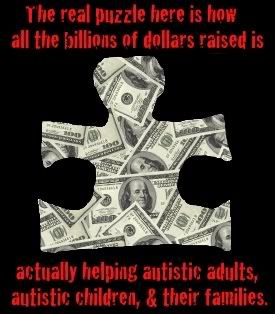
This story highlights some of those concerns. I think whether your child will continue to reside at home or live independently in adulthood, there are a mountain of questions, and very few answers. We all know the majority of money that autism charities receive is going toward research, studies, media, etc. Very little goes to actually benefiting autistic children and their families, almost nothing goes toward autistic adults. Since the pro-cure groups, at least some of them, are now admitting that our autistic children are becoming autistic adults, perhaps there will be more stories on this. Hopefully, as their children enter adulthood, they'll realize the need and use their media savvy and celebrity friends to get more programs and more money flowing in to benefit adult autistics.


FYI: The link to the article is found in the title, if that doesn't work:
http://mobile.newsday.com/news.jsp?key=152152&rc=bu&p=1

2/27/08

Celebrity "Autism Moms," Are You Listening?

Perhaps the Hollywood Autism Mom's club, along with the "celeb" mothers a la "Autism Everyday" could learn a thing or two from the so-called "bad-boy" turned obviously proud and devoted father, Colin Farrell. I wonder if they are listening?


Colin Farrell Says His Son Is Exactly the Way He Should Be

“He’s nothing but a gift,” Farrell, 31, said about son James on the Irish interview show Tubridy Tonight. With paternal pride he said: “As far as I’m concerned he’s exactly the way he should be.”

The genetic disorder, which can impair speech, movement and balance meant that James walked his first few steps last fall, when he was 4. “It’s just different,” said the actor. “It’s not different to me. He has his own path. He’s just brilliant.”

“I didn’t talk about my son [but] I felt like I was betraying him, like it could be misconstrued as shame, which would be terrible, because he’s such a celebration,” says Farrell.

Questioning the concept of “normal,” Farrell says his son is happier than so many people in the world. “I look around and I see people who move perfectly, who walk with grace, who speak with great diction and clarity and a great use of the English language and we’re all miserable f—ers – including me, at times.

“And then I see this fella who doesn’t move the way what’s perceived to be ‘normal’ is, and he’s as happy as can be.”


Wouldn't it be nice if one day a celebrity, or other parent in the public eye, speak such loving, passionate words about their autistic child--for all the world to hear? There's no pity party here for Mr. Farrell. He's not pleading for sympathy, contemplating jumping off a bridge, or spatting about controversial cures. No, he has taken a path (not often traveled by parents of autistic children we see over & over again in the media) in which he celebrates his son, advocates for his child and others with Angelman Syndrome. It is my hope that his words will inspire and encourage others to follow his lead (Jenny? Anyone?).


Bold & enlarged by author!! Link to complete article above.

2/26/08

The NYU Child Study Center Town Hall Meeting...hmmph

PhotobucketWell, I was hopeful. I even gave up a much-needed manicure for it. I have 3 hours a day to myself, for myself, where I have nothing to do but whatever the heck I choose. I felt strongly that today I needed to stay here at my laptop and see what this "Town Hall Meeting" was all about.

I will say I'm glad NYU Child Study Center actually did this, and I'm glad they are reaching out, it appears, to further this topic of public awareness (in, hopefully, a respectable manner). But, it seemed to me that while some good questions were asked, there weren't any answers. In fact, most responses felt more like pre-written soundbites. I don't know, maybe it was just me. The forum itself was a little flaky at times, it had a few kinks in it. My question was posted by "Anonymous" instead of the user name, S.L., I had chosen. Here it is:

What is being done for teens with autism etc., with regard to preparing them for adulthood, independent living, etc? Do you currently have programs in place to help these children (and their parents) ease into adulthood? It's great how far we've come with early intervention and the school system, unfortunately, at 18 or 21 , these individuals are essentially deserted, and often forgotten about.

And, the response:

Federal law mandates that at 15 every child classified with a disability begins a who are graduating from high school. Adult agenices are begining to understand the specific needs of young adults on the autism spectrum and plan more specific job support for them but we are just in the infancy of understanding how to truly integrate individuals on the autism spectrum into the workforce. in preparation for adulthood teens need to have a variety of work experiences, improve their social skills development and learn how to advocate for their own needs in the community. Professionals and parents need to ensure that these early steps are taken in preparation for adult life.
But what are you doing? What is NYU doing? From that "answer" I can only assume they do not have any such programs in place. The overall theme was "early diagnosis, intervention" and it appears they are holding onto that as being all that's needed. My daughter had early intervention (from before age 1 for developmental delays!), she's been followed by a neurologist from before she was a year old. Check, check. And now we wrangle our way through the school district, and hope they are helping my child in the best way possible.

I am still very concerned for her future. What will her options be after high school? What happens when her father and I are no longer around? What is waiting for her? Right now, the answer is nothing. I feel as if I'm running a marathon (unfortunately on a treadmill, as I feel I'm going nowhere) to find something for my child and all the others like her, who one day in the future will be 18. That day gets closer and closer, with only a bunch of talk about early identification and intervention, second to that is "cure."

2/18/08

Perhaps The Media Will Listen?

PhotobucketThrough the Autism Hub, I was recently notified about a letter from the AAP (American Academy of Pediatrics). They have recently been rather verbal regarding the show, Eli Stone (read Autism Vox for wonderful posts & background on this) and the storyline in which a fictional "mercuritol" apparently causes autism, yada, yada, yada. It's great to see a group so large, actually speaking out about something like this. The AAP feels very strongly that a show like this, and others, further promotes the anti-vaccine agenda, and this is very dangerous (see my video below, if you are unsure what skipping vaccines can lead to). I am glad that such a large, and well-organized group is taking such a stand. I cheered when I read this letter, it's wonderful to think that our side will be told in the media. Parents, and the public, must see the danger in not vaccinating, the harm of placing blame on something that science continues to dismiss, and furthermore, see positive, heartfelt stories of us loving our autistic child and embracing the life we have. Please get involved, if you feel you can. You may leave your contact info in my comments, or email at stopthinkaustismATgmailDOTcom. Here's the letter, and my video is below.

Hello,

As part of our ongoing response to media stories regarding autism and
vaccines, the AAP communications department is compiling a list of
parents who support the AAP and are available for interviews. We are
looking for two types of parents who could serve as spokespersons:

Parents of children with autism spectrum disorders who support
immunization and who do not believe there is any link between their
child's vaccines and his or her autism.

Parents of children who suffered a vaccine-preventable illness. This
could be a parent who declined immunization, whose child became ill
before a vaccine was available, or whose child was ineligible for
immunization.

We are asking for your help identifying parents who would be good
spokespersons. They do not need to be expert public speakers. They
just need to be open with their story and interested in speaking out
on the issue. We will contact candidates in advance to conduct
pre-interviews, to offer guidance on talking to reporters and to
obtain a signed waiver giving us permission to release their name.

If a parent were placed on our list, we would offer their name and
contact information to select media. We hope to build a list of
parents from a wide range of geographical areas.

As the Jenny McCarthy and "Eli Stone" stories illustrate, this issue
is likely to recur in the national and local media. The AAP is
committed to doing all we can to counter such erroneous reports with
factual information supported by scientific evidence and AAP
recommendations.

The anti-vaccine groups often have emotional family stories on their
side. The ability to offer a reporter an interview with a similarly
compelling parent who is sympathetic to the AAP's goals is a powerful
tool for our media relations program.

Please contact me if you have any questions or to suggest a parent to interview.

Thank you,

Susan Stevens Martin
Director, Division of Media Relations
American Academy of Pediatrics


If you've read my blog before, you most likely know my views on my own child's autism & where it may have come from. I strongly believe, I KNOW my child was autistic as an infant, as a newborn. I have no doubt her difficult time at birth was due to her autism, and neurological difficulties. We have a very vivid, very well-documented account of her developmental, physical and psychological health history from her birth. Her autism is apparent all along. I feel she was autistic from the moment we conceived her. I am often asked by other parents if I vaccinated my daughter. I say, absolutely! I tell them my fears of things like measles and other diseases my child would be at risk for without them. People truly don't realize that the diseases that have nearly been made extinct by vaccines are very lethal. In theory, skipping vaccines & possible toxins sounds great. Until your child becomes seriously ill or dies from one such disease.

I feel pictures say a thousand words. Here's my best argument for vaccines:

2/5/08

Gunnar Moody, Handcuffed At School...

We've all been bouncing illness between the family here, so I've been out of commission.  But, this came across my email & I had to get on and write.  My head is not quite clear, thanks in part to fever & medication, so I've included the original link to the story, as well as two other websites who have written on it (I no doubt much better than I!).


Gunnar Moody, 11, was handcuffed because, apparently, he was singing in gym class.  Gunnar is autistic, not that this should matter too much in this situation.  He is an 11 year old boy, in his gym class, singing a song, doing push-ups.  Now, granted, it's been a couple of years since I was in a physical education class, but I seem to remember it taking place in a gymnasium.  I also have some memory of those gymnasiums being rather loud, with bright lights, and noise reverberating in every direction.  I remember the smells and sounds.  The screech of shoes on the gym floor, the buzzing of the big, fluorescent bulbs above, and, yes, children making lots of noise.  Gym class, much like recess, is a time for children to move, let out their extra energy, and have fun.  It is the time you are able to let loose a bit, and certainly time to chat.  Heck, even time to sing.  Most days, our gym teachers would even play music for us during class.  

Well, perhaps I grew up in another time?  Maybe it was because I grew up on the other coast?  I have thought this over, and I cannot come up with any good reason why cops would be called in here, and certainly cannot fathom why handcuffs were used.  I can't help but feel with 100% conviction he was treated like this because he was in fact autistic, and no other reason.  So, it does matter, that Gunnar is autistic.  But, it shouldn't.  He should just be any other 11 year old, trying to pass the time as he does his sit-ups, by singing.  And no child, in this situation and all the facts as they've been presented to me, should be handcuffed for this.

Back to the autism factor.  Let's think back to my memories of gym class.  The noises, the smells, the physical action, the lights, it all comes together and anyone with experience with autism or sensory issues can easily see that gym class could be problematic.  The psychologists and other professionals I have spoken to have said that quite often recess, lunch, and gym class can be the more difficult time of day for autistic students.  This, I imagine, is common knowledge.  It doesn't seem like a hard idea to grasp.  Those three periods in the day are where social demands increase, as do the sensory assaults (the odors in the cafeteria, sights and sounds of the outdoor playground, and again the gym).  

This child had a behavior plan.  This behavior plan stated what steps the school staff should take in an event like this.  An event where Gunnar perhaps was having difficulty transitioning or stopping a behavior.  This behavior plan does not include the use of physical force.  Therefore, the school did not follow the plan set forth just for this situation, a plan agreed to by the school and Gunnar's parents.  This is frightening for any parent who has spent hours upon hours (and possibly many dollars for an advocate, etc.) researching and advocating, working with the school district, and then finally compromising on an agreeable IEP and behavior plan.  We sit in those meetings, hours on end often, and each member there signs the papers.  With handshakes and signatures, we all assume that we have sealed a deal.  That what we have written is THE final word on how our child will be treated during the time they are at school.  

This is another prime example of an autistic person not being afforded the same rights as any other individual.  Shame on the San Jose Unified School District.  They obviously are in need of an overhaul on their policy, how they observe IEP's and behavior plans, and certainly, how they handle situations like this, especially with autistic children.  This child says he does not want to return to school.  I feel for this family.  I think of my daughter, and her future.  It is stories like these that again tell me, we need to keep fighting.  Until society accepts our children, and works with us, autistic children will continue to be abused, continue to be handcuffed, and continue to be discriminated against.

1/16/08

Shame On The Media (again)

A verdict is due any moment in the trial of Karen McCarron, the mother who viciously suffocated her 3 year old daughter to death. Her daughter, Katie McCarron was a beautiful, precious, and happy little girl, she was also autistic. The media coverage has been sparse, and this story has gotten very little national attention. Thus far, every article or story I have read or seen leaves out a very crucial image--a picture of Katie. Most have no pictures, others show only Karen McCarron.

I have found, also, that most stories use lines and words like "...little girl was asphyxiated..." and "smothered," all take away from the fact that a mother murdered her child--held a plastic bag over her face for at least two minutes. The stories also include lines like this, telling us how much Karen McCarron suffered and how she "longed for a life without autism..." Where is all the outrage in the media? What advocacy groups are standing up for Katie?

The overall theme is that autism was to blame for a mother killing her own child. Karen has pleaded not guilty by reason of insanity. This woman was so insane, or so her attorney claims, that she drove her child to her parents' house, where she knew no one was home. She killed her, then drove Katie's lifeless body home. She carried her upstairs, passing by others in the home, pretending that Katie was sleeping. She then ran errands, and later went to "check in" on Katie. She then put on a convincing act that Katie was suddenly not breathing and began CPR. It was not until hours later when, I suppose, she felt some pangs of guilt and apparently tried to kill herself, that the truth came out.

That is not insanity. An insane person would not be capable of such a cover-up. We wish, as a society, that this person, this mother, who committed such a horrifying act was indeed insane. We hope that a person was unaware of what they were doing, and incapable of realizing how wrong it was. That is the only way we as humans can make sense of such a tragedy. A mother can't be so full of evil and selfishness as to take her child's life, right? Wrong. This woman is not insane. She knew what she was doing.

Autism is not to blame, autism did not kill this child. Katie's grandfather has described her in the most beautiful of ways, please, you must read this.

This murder again leads back to groups like Autism Speaks and most other supposed autism charities. These groups support the idea that autism and being a parent to an autistic child is sheer terror. They promote falsehoods such as autistics are lost, missing their souls, etc. They celebrate mothers who admit contemplated killing their own child, and lift her up as their heroic poster-mom. They further the idea that autistics are not due the same human and civil rights as the rest of us.

I pray this jury does not buy into her plea, or buy into the fact that autism is the true villain here. I pray there will be justice for Katie. I pray it will bring even just a little bit of peace to her father and grandparents.

Kristina Chew, PHD., on her AutismVox blog has been giving trial updates daily.

Still think that "cure" groups like TACA, DAN!, etc. are entirely innocent here? READ THIS!

I have to add, I am very upset and distraught over this story. I have been blunt here, but I feel it is necessary. My family, my friends, had never heard of Katie McCarron. The world should know her story. Katie's murder occurred several months after we first began to suspect my daughter was autistic. Hearing of her murder was actually the first time I had heard of an autistic child being murdered. It was startling to me. Katie's story stuck with me, her picture engraved in my mind forever. It was a stepping stone that led to this blog, and to me being fired up about advocacy and acceptance. Katie was murdered within a day of my child's birthday. When I see the pictures of Katie and hear stories about her from her loving grandfather, all I can think of is my own daughter. They seemed to be a lot alike. I can't imagine a day without my precious child, she is so amazing and I am blessed to be her mother. It is incomprehensible to me how a mother could feel any different. This truly breaks my heart.

1/11/08

A Letter Worth Learning From...

Must be the day, I seem to keep coming across worthwhile stuff, from parents:

This is a great letter, from a parent to her autistic daughter's kindergarten teacher. It's helpful for other parents, full of ideas on how to help a child through their school day. It is inspiring because you can tell this mom cares about & believes in her child, and is willing to offer any help and support for her child. These are easy accommodations, and I think the general public could stand to learn a bit from this type of letter as well.

1/7/08

CAICA & Hating Autism: What Is Going On Here???

UPDATE HERE: PLEASE READ!!!
The material has been REMOVED!!!

It was brought to my attention through the Autism Hub that the website for CAICA has several blog entries from the "Hating Autism" blog. I was honestly rather shocked that such an organization would post anything from this blog. The Coalition Against Institutionalized Child Abuse (CAICA) is a website I often refer to to spotlight the abuse that takes place everyday against children in institutions, hospitals, "treatment" centers, boot camps, etc. I have found it very helpful and informative. I was disappointed that they would actually print anything from a blog that often spews hatred, and furthers the type of stigmatization and discrimination against autistics. These beliefs are what leads to the abuse of children, the same children that CAICA is supposed to be fighting for.

The biggest issue here is that when you visit the page where this blogger's postings are listed, you have no clue who he is, what his experience is, etc. One may well think he is some sort of expert, and therefore take his information as fact. This is very dangerous. The page can be found here. It's troublesome to me that they kept the post's title of "Autism don't screw around," for their web page title. That is something else to ponder regarding CAICA and their views on Autism. Some of the more startling statements I came across on this page are here...

I believe the reason that the flu shot is pushed on pregnant women is because they need to cause more autism. Causing more autism when everyone is being told that the mercury is out of the vaccines is a great way to make the uninformed public agree that mercury could not have caused the epidemic. They have to cause more autism because, if autism suddenly disappears, it will help prove the case and the vaccine manufacturers stand to lose over a trillion dollars. The manufacturers don't have a trillion dollars which is why they have paid politicians to change the laws to prevent most parents of autistic children from filing lawsuits.

If anyone is reading this who knows someone whose child has not tried biomedical intervention, please ask them to read this. And, tell them to get in touch with Generation Rescue to learn how to save their child.

It's easy for parents to get frustrated and give up. The only chance our children have is for parents to keep going to beat this son of a bitch named autism.

The object of any professional who works with autism should be to get rid of the autism. Settling for some half-assed improvement is far from professional in my book. Teachers need to learn that they can do their jobs a lot more effectively if the children they are teaching are receiving the medical treatment they need to remove the poison that caused the autism.

A link to his blog (yes, with the title right there, "Hating Autism" for all to see) is on the bottom of the page. It is perplexing why CAICA made the decision to post this hateful, paranoid ramblings, plus a link with such a title. Seems very much against their Mission and Purpose Statements. I have written them, asking they remove the postings, and hope they find more alternative, accurate, informative, and positive material to have on their site. I really hope that if enough of us rally together, as was done with the Ransom Notes campaign, we will once again have success.

Please join me by contacting CAICA at info@caica.org. Thank you!

1/4/08

My Ransom Notes Letter...

I meant to post my letter last month...but we were all sick here and the holidays turned things upside down as usual. So, finally, here is what I sent to Dr. Harold S. Koplewicz at the NYU Child Study Center.

Dear Sir,

I am writing to voice my concern regarding the ransom note campaign that your Child Study Center will be running. I am the parent of an autistic child, and I myself have had to deal with depression, ADHD, & OCD. I do not think this campaign will be helpful to anyone. It does not help parents identify signs or symptoms, if a teen or child reads the signs it will surely make them feel more hopeless.

Furthermore, each ad stigmatizes the diseases and disorders. The themes of possession and kidnapping do nothing but spread the idea that those who suffer are inhuman. As a child and teenager who required fairly intense medical intervention to overcome some serious issues, I know how society judges and treats the mentally ill and the disabled. The public doesn't understand. Ads like this push the public into further misunderstanding, and promote stereotypes. It was my understanding the goal of this campaign was to spread awareness and end the stigma surrounding these conditions. I feel this campaign is doing just the opposite.

As an artist, I do see the attractiveness and creative angle of these ads. They are also eye-catching and thought-provoking. Unfortunately, they lack accurate and helpful information. They tend to be more of an ad to promote fear and hopelessness. I sincerely hope you will reconsider these ad campaigns, and further ads will be of a kinder, more accurate, and more helpful nature.

I wish I'd had the time to post a celebratory post a few weeks ago when this all came down...I'm thrilled to see the great change we all created. It surely has refueled me, and also made me feel like real change can happen. I think more & more voices are being heard each day, and while we have long road ahead, it is more possible than ever for us to achieve all we are fighting for. I am filled with hope for the New Year.

Happy New Years!

12/8/07

NYU Child Study Center: Ransom Notes Campaign

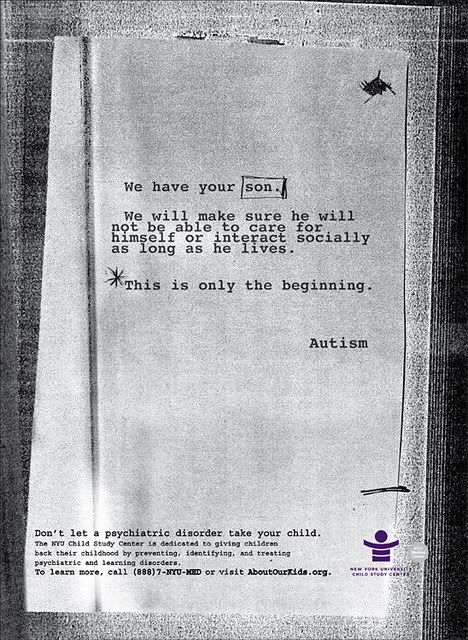
I just opened the email from the NYU Child Study Center regarding their campaign for "public awareness" for childhood psychiatric disorders. This is their intro before they show the posters.

Don't let untreated psychiatric disorders take your child.

The NYU Child Study Center's "Ransom Notes" public service campaign is designed as a provocative wake up to create awareness and spark dialogue about childhood psychiatric disorders, one of America’s last remaining silent public health epidemics. Twelve million American children and adolescents face daily battles with psychiatric disorders. Untreated, these children are at risk for academic failure, school dropout, substance abuse, suicide, unemployment, and imprisonment. Children who do receive appropriate treatment, however, can learn to function and thrive.

"Ransom Notes" may be shocking to some, but so are the statistics: suicide is the third leading cause of death among young people ages 15 to 24, and serious emotional problems affect one out of 10 young people, most of whom do not get help. The strong response to this campaign is evidence that our approach is working. We acknowledge the challenges faced by individuals with these disorders and their families. We hope to both generate a national dialogue that will end the stigma surrounding childhood psychiatric disorders and advance the science, giving children the help they need and deserve. We want this campaign to be a wake up call. Please join the dialogue.

There is nothing here that I find wrong. I hope every child suffering from depression or who is suicidal receives help. I think there does need to be a national dialogue, better information for parents and teens, training for educators, etc. I do feel more needs to be done for teenage depression and other similar issues. It breaks my heart that children and teenagers are affected by this. As a teen, I too battled depression, and was suicidal. This led to inpatient care at a facility, years of counseling, and medication. When I see myself as a teenager, I wish so much I never had those feelings & that I had accepted and appreciated myself. I wish I had one shred of self-worth. I had issues with self-esteem, anxiety, OCD, & also ADHD. I remember feeling like a freak. I remember the awkwardness of returning to school after being hospitalized--I had missed the first 2 months of school. Thankfully, I was accepted by my classmates. This is a rare exception to the rule. I was blessed to attend a school with (for the most part) very grounded individuals. Overall, we didn't judge and the various "cliques" all hung out with one another. Thank God for that--I can't imagine being stigmatized for my personal issues, especially at that time when I was very fragile.

So, I hope a day will come where other kids & teens who are dealing with emotional or psychological disorders will not be judged or criticized. Most often, it's the parents who have issues. Either they're upset their child is "not normal," or they blame themselves, or they are ashamed and don't want neighbors, friends, or even family finding out what their child is going through. It's something that is whispered & shamefully admitted. You shouldn't feel ashamed if you are having emotional or psychological problems. I am all for an ad campaign that would promote awareness and acceptance. I think some parents do miss the signs, while their child suffers. Ads that would alert parents to the obvious & often-missed signs would be helpful.

The NYU Child Study Center claims its aim is NOT to stigmatize childhood psychiatric disorders. However, after reading these ads, I was disturbed. I honestly feel they are doing that which they intended not to do. For one, I'm not entirely sure why they grouped together Autism with Depression, etc. If their concern is depression & suicide, address that. Whether someone is autistic or not, help their depression. Why were the posters for autism put into this campaign? They seem like the odd man out.

First & foremost, the majority of families who have a child with Autism, Asperger's, or ADHD often are obviously aware of it. An ad campaign like this--supposedly geared toward teenagers or parents of teens, does nothing to help parents or autistic young children. So, to make posters like these--which once again, creates a stigma that people on the spectrum are inhuman, is pointless & harmful. The words that are used are: "possession," "detriment to himself and those around him," "destroying," "life of complete isolation," and then the Autism poster which is a long sentence of hopelessness & despair.

The posters are inaccurate, further give weight to existing false & hurtful stereotypes, and, again, DO NOTHING to help either autistic children, teens, or adults, or their parents and family. So, what is the point?? Is there a connection here to Autism Speaks that I am missing out on? Or is it simply that this Child Study Center sees how successful Autism Speaks has been with their fear & dread campaigns, that they want to rake in the big dough too??? I'm so sick & tired of these "foundations" preying on the fears of parents & basically using my child to make a lot of money. A lot of money that will do NOTHING for my autistic child.
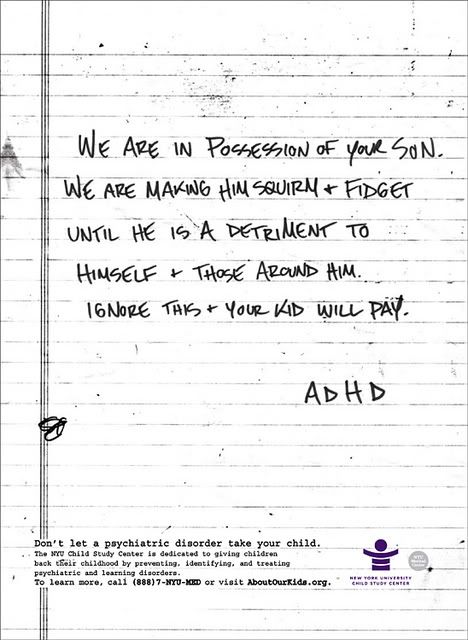
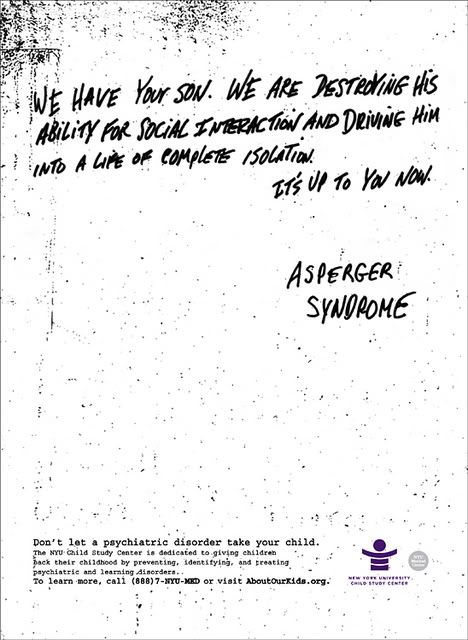
Photo Sharing and Video Hosting at Photobucket

Photo Sharing and Video Hosting at Photobucket

Photo Sharing and Video Hosting at Photobucket

So, with these posters, who are you helping? Are you really making parents aware? Odds are, this type of "awareness" campaign will not help parents. Their children will most likely get a diagnosis, if they truly have ADHD or Autism. So, who are these ads for then? They are the same propaganda that Autism Speaks sells--Autism has stolen your child, he is not human, he should not be afforded civil rights.

How about a poster about how people who fidget or don't make eye contact or may have difficulty in social settings be accepted? How about identifying these people as valuable members of society? How about respect? What about teaching kids it's not right to bully someone, simply because they are different. This center had an opportunity, obviously they had the funds, to make a campaign that would de-stigmatize Autism and the psychiatric disorders they are talking about. But, they neither achieved the ability to create public awareness nor truly help the people they are supposedly advocating for.

I have a little less negativity toward the posters on OCD & depression. I'm not offended by them as I am by the ADHD & Autism ones--those are highly offensive, in my opinion. I do have issues with them, however. With regard to OCD, typically, if someone has it to the extent that they need help, it will be fairly obvious. If a parent doesn't recognize the signs, that is a result of poor or absent parenting. All the posters in the world will not improve that. I used to count everything, and I mean everything. I hated public restrooms. For years, I never touched a doorknob--either I'd have someone else open the door, or I'd cover my hand with fabric. I had many rituals. If you spent a 1/2 hour with me, it would be very apparent. I did need help, and because it was obvious and affecting my life, I received the help. Honestly, if your child is not washing their hands until they are raw, would you realize they had OCD from this poster? It breeds fear with the last line of, "This is only the beginning."
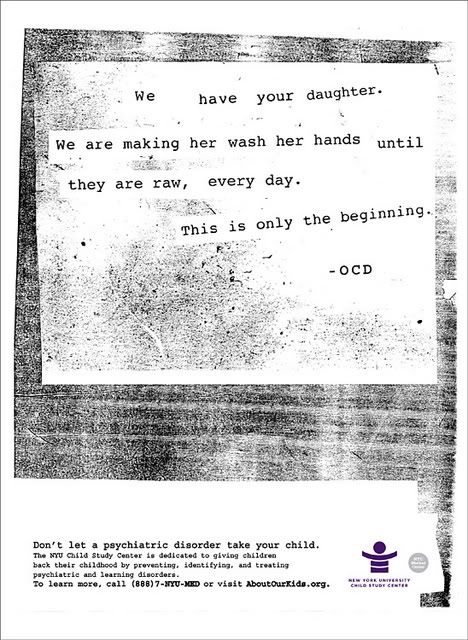
Photo Sharing and Video Hosting at Photobucket

The fear-mongering continues with the depression poster. While I do agree the statements made in the poster do depict what depression can do, I do not like its delivery. What does this poster do to make someone aware of depression? Would I realize my teenager was depressed after reading this? The only parents this will help, are those who are well-aware their child is depressed. Perhaps it will prompt them to get more help. But, to be honest, this is a very small minority. I hid my depression very well from my family. I'm great at putting a smile on my face & hiding all of my emotions. I was a cutter. I hid that well too. It was not until I was to the point of killing myself, that my family became horribly aware of the reality of my situation. A poster like this would not have had an affect on my family. So, again, who is this helping? If I'm a teen who is depressed, reading this, would most likely make me even more depressed and feel more helpless.
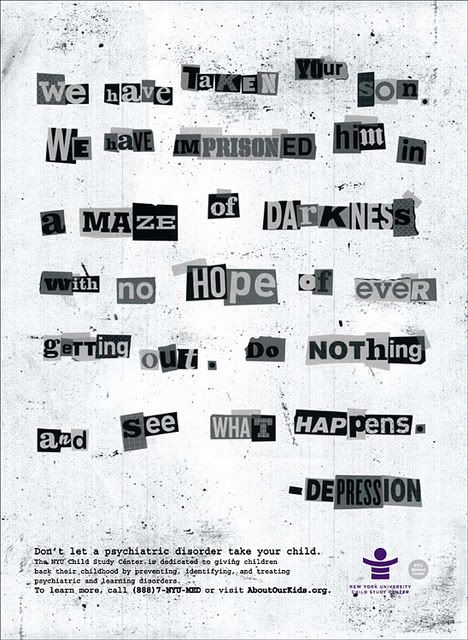
Photo Sharing and Video Hosting at Photobucket

Along with my boatload of problems mentioned above, I've also had issues with food & diets. I've starved myself and binged and purged. To be honest, the bulimia poster is the only one I don't really have a problem with (& by that I mean, this poster alone would not lead me to write this blog entry, call & write the center and its sponsors, and email everyone I know about this ad campaign, and how to fight back...), as far as its content. Again, the delivery sucks, and I hate all the dark, fear-inciting, kidnapping theme. They really think it's not stigmatizing?? The problem also is, again, who is this helping? The parent who is aware their child is bulimic or anorexic, may be prompted to get more help after seeing this. But, for the vast majority of parents who are clueless to their child's eating disorder, this does nothing for them. How about listing some signs of what to look out for? You could have this same poster, but be sure to show what to look out for. Marks on their knuckles, going to the bathroom right after a meal, dental issues, hair falling out, etc. There are PLENTY of signs to make parents aware of.
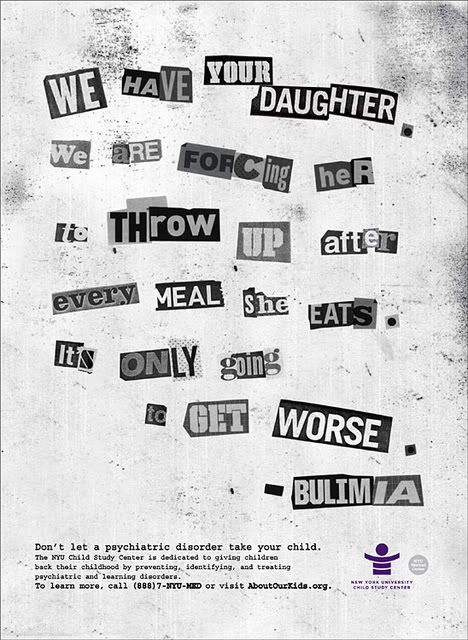
Photo Sharing and Video Hosting at Photobucket

So, overall, I give this ad campaign a big fat failing grade. Not only does it not promote awareness nor help parents, it stigmatizes & promotes stereotypes about ADHD, Autism, & OCD. I wonder the price tag on this venture. I wonder all the good those types of funds could have done, if put in the right hands. Posters & pamphlets for parents, with pertinent information. Posters & pamphlets for children and teens that promote acceptance, discourage bullying, and let affected kids know they are important and valued.

Please, be informed:
http://www.autismability.com
http://www.autisticadvocacy.org

And, get involved, voice your opinion:
NYU Child Study Center:
Dr. Harold S. Koplewicz
Phone: 212-263-6205
Fax: 212.263.0990
Dr. Koplewicz's E-mail: Harold.Koplewicz@nyumc.org
Communications Department:
Beth Rowan, Director of Communications
212.404.3757
Beth.Rowan@nyumc.org
NYU Child Study Center
577 First Avenue
New York, NY 10016

Also, check out:
http://autisticbfh.blogspot.com/2007/12/held-for-ransom.html
http://djdialogue143.blogspot.com/2007/12/follow-up-from-yesterday-my-letter.html


And...a DELAYED update, but a great news update none the less:
http://www.autismvox.com/ransom-notes-campaign-is-over/


10/30/07

Normal People Scare Me


I really couldn't think of a better title! I am ordering this dvd, & really excited to see it in full-length. I know this YouTube piece has been out for a while, but I just came across it. So, figured I'd share, in the event someone else missed it too.

So much of what we, the general public, see of autism is very negative. The majority of news pieces and interviews done feature parents, researchers, therapists, and doctors--very rarely autistic people. The conversation generally involves searching for a cause or a cure, controversial treatments, the financial and emotional stresses felt by families, and all too often, autistic children are portrayed as wild, out of control, and completely disconnected. Their parents cry and talk about how painful it was the day their child was diagnosed, and they speak of the daily anguish they feel, living with autism. Many times, the talk becomes even more hopeless. Some parents describe autism as having "stolen" their child's soul, that it's as if their "child was kidnapped," they compare autism to cancer, and some have even admitted contemplating killing their child.

I have no doubt that if the topic was something other than autism, the public would not stand for this type of hate speech. If the parents of diabetic children came out and said that the day their child was diagnosed with diabetes, they felt like their life was over. People would be appalled if these parents continued on, complaining about the cost over medical care for their child, how time-consuming checking blood sugars was, and how stressful it is to maintain a special diet. If they said it was as if their child had been replaced by some other child, that this just wasn't the same child they had before diabetes, people would have to pick their jaws up off the floor.

Can you imagine...

An ad campaign for juvenile rheumatoid arthritis, a father declares:
"I didn't choose this."

On this year's MD Telethon, parents shake their heads, saying:
"You just keep being disappointed."

The father of a child with cerebral palsy:
"I really hope I'm not changing his diaper by the time he's six and a half."

The next St. Jude commercial:
"I actually contemplated putting my child in the car and driving off a bridge."

The mom of a child who is in recovery from leukemia, when asked if she was going to have any more children:
"I'm done having children. I always thought I'd have at least four or five. But I got my a-- kicked."

I am pretty sure these parents would be advised to get psychiatric help. Perhaps in some cases, child protective services would be called in. There would be no excuse for any of these parents to make public statements like the ones above. Yet, the ones above were made and continue to be made by parents of autistic children. And no one says a word for. It is unforgivable. Stop the hate speech NOW.

Support & promote videos such as the one above. If you truly care about what kind of life your child will have in 5, 10, or 20 years, this campaign of shame and blame needs to end now. How do you expect anyone to offer a job, or services, or living arrangements to someone who for years has been portrayed as being inhuman, wild, disconnected, soulless? Personally, I don't want my child to have to fight the public and their cruel misconceptions her entire life.

Photobucket