Having an autistic child is not the end of the world--far from it. It is my hope that through this blog, at least a handful of people will get to understand that. My child is amazing, she brings us tremendous joy. We have good days & bad days, but we CHOOSE to focus on the good. Our belief is that by loving our daughter, giving her the most comfortable environment we can, and by most of all accepting her differences, she will continue to blossom--in her OWN way.

Showing posts with label The Future. Show all posts

7/21/08

Savage Ignorance

Unless you've been hiding under a rock (or on the road traveling like me), you have heard of the ridiculous comments made by radio talk show host Michael Savage about autism.


From several sides, his comments are offensive--and very flawed. Let's start with this claim that in "99 percent of the cases, it's a brat who hasn't been told to cut the act out. That's what autism is..."

Really? That has got to be one of the most ignorant statements I've heard with regard to autism (and trust me, I've heard plenty). So, Mr. Savage, you mean to tell me that only 1% of the children who are diagnosed with autism--who attend special programs, therapy, etc. for their autism--only 1% are actually autistic? Based on those odds, it's very likely that in his mind, my daughter or anyone of her classmates must not have autism, or the kids who attend the same therapy center, most if not all, are not autistic. Right, that makes perfect sense Mr. Savage.

Then there's the fact that he views autism as a "fraud, a racket." I'd love to hear how exactly he concluded this. Is my daughter acting, putting on a show? Are we as a family gaining something from some sort of sham, from "faking" autism? Exactly what kind of "racket" do we have going on? I'd love some explanation--but again, these are some of the most ignorant and nonsensical statements about autism I've ever heard.

He spirals even further downward, placing blame on the fathers (which is an interesting twist, typically it's us moms who get the blame from misguided people). Apparently, Mr. Savage also is unaware of girls like mine, who are also autistic. His rant centers around the idea that boys are not being yelled out by their fathers, and that's why they are being diagnosed with autism. Fathers, according to Savage, should tell their sons:
"Don't act like a moron. You'll get nowhere in life. Stop acting like a putz. Straighten up. Act like a man. Don't sit there crying and screaming, idiot."
This was especially disturbing to me. Not too long ago, autistic children were called many horrible names by the medical community. Today, sadly, there are too many in society who still refer to our children with vicious insults. The words "putz" and "moron" (and "dummy" which Mr. Savage also said later on) were bad enough, but "idiot" really enraged me. Years ago, my child would be labeled an "idiot savant." She has an extremely high IQ, uneven skill sets (splinter skills), yet her social, adaptive, and communicative skills are rated in the very low to low range.

I never thought much about the word "idiot," it easily rolls of the tongue of most people. But in the last few years, it's had new meaning to me. Our neurologist first said "idiot savant" following our child's first IQ test, explaining how a person could have a genius IQ along with developmental delays, etc. We were utterly perplexed by this concept. Our neurologist said "the outdated term you may be familiar with is 'idiot savant'." I know how society used to treat "idiots" and "idiot savants." I also know how history has a way of repeating itself. This is not a word I would ever use in reference to autism or autistic individuals. Shame on you, Mr. Savage!

I would invite Mr. Savage to come stay with our family for a week, or even a day. Then perhaps he could enlighten me on how we were benefiting from this autism "racket," and how my child was really just a "brat." Maybe he could show my husband how better to berate my child, so she wouldn't act the way she does. I wonder what Mr. Savage would say to the neurologist, psychologist, developmental specialists, pediatrician, special ed teacher and para, and multiple therapists who see my child, have diagnosed her, and so on. Are they all in on this sham too? I am curious to hear this man's recommendations.

Savage's comments are, at best, a big fat waste of breath. I considered not even writing about them. They are ridiculous, and not really worth my time. However, Mr. Savage has a huge following (upwards of 10 million listeners) and therefore his words can alter millions of people's views on autism. That can be dangerous. The last thing we (autism families, autistic individuals, and society as a whole) needs is more stigmatizing, stereotyping, and mocking.




6/11/08

Warning: This Is Nothing To Laugh At

If someone feels they are an Indigo and they believe in this concept, that is one thing. I don't agree, but who am I to judge? However, if your beliefs are in any way detrimental to children, I take issue. Major issue. Here is the start of my concerns over the Indigo concept.

From here, it is suggested that "vibrations" will interrupt seizures, among other startling claims:


From vibrations sounded mentally that will interrupt seizures and stabilize brain function to attitude adjustments which free mind and body from long-standing, stagnation-producing concepts to the mental and emotional state of the comatose, the research is astounding and deserves to be noted, explored, and utilized more widely.


This site offers ill-advice for a febrile seizure:
If a seizure occurs, keep your child upright if possible and make sure she is breathing well. Reassure her. If she vomits, turn her on her side.

As a mother of a child who has seizures, this is awful advice. We have always been told to immediately put our child on a safe, flat surface (it would be impossible, at least during my child's grand-mal/tonic-clonic seizures to sit her up). If she begins to vomit, we turn her slightly on her side so she doesn't choke. Here is what NINDS advises:
To prevent accidental injury, the child should be placed on a protected surface such as the floor or ground. The child should not be held or restrained during a convulsion. To prevent choking, the child should be placed on his or her side or stomach.

I fear that there may be children out there who are not being properly treated for seizures (thankfully, it seems Jenny does take her son's seizures seriously and he is treated medically for them, but others may not be so wise). It seems likely that a child diagnosed with ADHD, autism bipolar, etc. whose parents feel s/he is a Crystal, may not be afforded all available help or treatments. There are people who, despite the best efforts (at alternatives like talk therapy), they need antidepressants or anti-anxiety medications. Without, they can be at risk for suicide or other negative outcomes.

As I read more into the Indigo concept, I couldn't help but draw even more similarities to Scientology. The dangers that have come from Scientology's stance against all things psychiatric have been widely, and tragically, documented. I came upon this, and it would seem that New Earth Magazine looks highly upon L. Ron Hubbard (founder of Scientology):

As an aside, L.Ron Hubbard of Scientology says that the more they can avoid the indoctrination of the school system, the better off they are in this world.

I think extreme caution has to be used when a group disregards medically-accepted diagnoses and treatments. They continually dispute scientific studies, promote conspiracy theories, and regurgitate the same information and sound bites over and over again. When this group storms Washington, D.C. and promotes an ongoing campaign to alter the (historically substantial and successful) vaccine system in the U.S., it is concerning. When this same group and its bombshell messenger employs tactics in an attempt to oust a government official, we need to take note. When they are given nearly free range on the media, to push their propaganda, we cannot sit idly by.

I've mentioned my concerns previously with regard to Ms. McCarthy and her message. Personally, I have nothing against her as a human being. I can relate to her, when she speaks of her son's seizures. However, the reality I face is that there is a startling lack of services for teen and adult autistics. My daughter is still rather young, and I do have time. However, I know plenty of other families and individuals who are in great need of those lacking services NOW. And, it's clear that unless major initiatives are made soon, we'll face the same issues with our daughter in a few years.

Jenny, despite what some will claim, has done nothing to further this effort. She continues the stigma that autistics have been "kidnapped" or her personal favorite, "hit by a bus." She focuses on recovery, telling the world she doesn't know of any adult autistics (so why bother creating any new programs?). Her loud cries that she would never vaccinate a child again and that she feels you should alter a proven vaccine program, is risky.

I worry for what the future will bring my child--will she have proper assistance? paths to independence? acceptance? And now I fear if I can protect her from outbreaks of whooping cough, measles, and the like. It's clear that this disturbing message will sink even further from my goals. We have no time to waste, to get programs created and funded for teen and adult autistics. This is all a huge distraction, one that unfortunately, all of the public is listening to.

You now know where this is headed. There is nothing funny here at all.

6/10/08

Autistic and Proud

PhotobucketIf you missed the piece this morning on Good Morning America, you can find it online here. There were some wonderful moments, both from Ari Ne'eman and Kristina Chew. I was delighted that ABC included the Ransom Notes campaign, and how our community came together and dissolved it. Transcripts from the show are also available on ABCNews.com as well.

Ari Ne'eman said this early on in the interview, when speaking about a cure for autism, and why some parents are upset over this:

"I think that one of the key issues to remember is that anti-cure doesn't mean anti-progress," he said.

That is so important. People hear "acceptance" and they assume ignorance and even laziness. Accepting my child, accepting autism, does not mean I sit around and allow her to struggle through her life. What it means is that first and foremost, I see her and treat her as the unique, beautiful individual she is. I respect her and love her. I have learned so much from her, she is a gift, and I really am lucky. I do all I can to help her, to ensure she has the skills she needs to reach the next step (realizing it may take a long time to get there, and there may be hurdles along the way).

"Where does disability come from? It comes, in many respects, from a society that doesn't provide for an education system that meets our needs. From people who often discriminate or bully or even injure us, and from a society that is largely intolerant," Ne'eman said.

Society is very intolerant, we see that time and time again. I have always thought of my home as refuge from the world--and now for my youngest, refuge from a society that can be very cruel. I see it in stranger's eyes when she is having a meltdown in the store (the "can't you control you child?" or "what is wrong with you?" stares and glares). Or the perplexed look on another child or even parent's face if she is struggling to do something (a milestone achieved by children younger than her) or when she is hyper, spinning in circles or making odd vocal noises. You don't realize how judgmental the world is until those moments. I always had such hope for the world, it's easy to become jaded when you are in my shoes. Judge me, that's one thing. But, I never dreamed society would judge a young child. It's disgusting.

Lenny Shaffer, a writer with an autistic son, says of the movement, "You're a handful of noisy people who get a lot of media attention, but you don't represent a broad swath of the autism community."

Ne'eman believes history is on his side.

"I can't think of the civil rights movement throughout history that hasn't been faced with resistance and misunderstanding on the part of its detractors," he said.

I really have to disagree with Mr. Shaffer's perception of the "Neurodiversity" or autism acceptance or autistic pride (or whatever else one may call it) movement. I see our numbers growing each day. I see it most apparent out in the world, with parents of other children in our community. To be honest, most of the parents who I know who feel as I do, they simply go about their day and their life. They aren't seeking media attention or attending rallies. They have no beef with the government or with vaccines or anything else. They focus on helping their child, dealing with the schools, and just with living life with autism. Those who feel it is wrong for us to "accept" autism, they tend to shout louder and love the camera. But, I honestly feel that we are a rather large, and growing, part of the autism community.

"We really try and understand him on his own terms," she said.

That is her advice for parents dealing with a child's autism diagnosis and feeling hopeless.

I couldn't agree more with Kristina. I'm grateful for having (by coincidence and luck I suppose) known a few parents of older autistic children just prior to and around our diagnosis time. They gave very similar advice. There was always a lot of optimism in their message. I have never forgotten their words. My daughter has made tremendous progress, I credit part of that to the fabulous doctors and therapists we have (and knowing she was delayed and needed help before age 1). The other part, and I strongly believe this, is that she has a loving place of acceptance to live in. We do not force her into how we think she should be. We realize she often finds comfort in rocking, flaps when she is excited, and has her own "brand" of play. We understand that eye contact can make her uncomfortable. We do our best to prepare her for social outings, changes in routine, etc. We follow her lead, in many ways. I don't think she would be where she is today, if we focused on changing behaviors or actions that society perceives as odd. She is so connected to us, and each day opens up more to us. We'll be able to help her so much more, because she will know we are trying and that we respect her.

The interview ends with Kristina saying this, a beautiful message that we all should remember:

"Acceptance, to me, is the beginning of hope," Chew said.

I want to thank Ari Ne'eman and Kristina Chew for their wonderful interviews. I truly feel these messages are what will lead to change for our children and for adult autistics. I applaud ABC, along with Deborah Roberts, Michelle Major, and Jonann Brady for doing this piece. I hope it is only the beginning of many more.

5/14/08

The Question That Led To Many Questions...

"What is wrong with her?"

This is what a classmate of my eldest child asked, regarding B. It caught me by surprise. For one, over the year, A's class has seen her little sister. They've also heard my daughter speak about her. So, I assumed all the kids understood: she's different. I guess not. Perhaps hearing stories or explanations, and seeing a child in the special ed group is one thing. Actually spending time with and being near to that child is another.

B has great difficulty in new settings. She has a very hard time with new people, especially children. On the day this question was posed, my little one was having to tackle both. We were in a semi-strange classroom (her sister's room, which B has been to only briefly twice before) and, of course, it was full of children. The visit began with anxiety and tears, B not wanting to go in the room. However, I had to be there in the room to help out. I reassured her, and we made it into the room without anymore difficulty.

Her sister swiftly found crayons and paper for coloring (did I mention A is the greatest big sis ever?!). We sat at the teacher's desk, and she colored. The children were busy with a quiet activity themselves. The boy sitting closest to us attempted to converse with B. "Does she talk?" he asked, after getting no response from her. "Yes," I said. Indeed, she is verbal (very silent in situations such as these though). The boy continued to say "hi" and tried to get a response from her. She burrowed herself into my chest (something that becomes harder and harder as she grows and gets bigger). I told B she could wave if she didn't want to say hello, she did neither. The boy eventually got bored and went back to his work.

A while later, she was done with coloring. We walked over to the book corner. B was very hesitant, not wanting to be exposed out there, in front of the class, in front of those children. She clung to me, and we carefully made it to where the books were kept. As we were picking out a book, that's when I heard "what's wrong with her?" The little girl asked, half concerned, half aggravated. I can't pinpoint what made her ask this question. So many of B's mannerisms are now normal to me; I have a hard time deciphering what is deemed abnormal by others. Was it because she wasn't speaking? Because she stared down at the ground, never looking at the class? Was it her whimpering? Perhaps she was stimming, or was it something else?

I guess I was caught off-guard because at the time, as far as I could tell, she wasn't doing anything overly exaggerated. She wasn't having a meltdown, she wasn't rocking, flapping, or walking in circles, she wasn't shrieking or doing anything else that would make her appear obviously different. And yet, an elementary student picked up on the fact that something was different about my little girl.

I was perplexed and bothered by the question. I had assumed that these kids understood her. Sounds silly to me now, to expect that from children. I also thought that in her quiet moments, B blended (not that it's some goal of ours, just an assumption of mine). I'd even heard from people here and there when she was younger, that at first glance, they'd "never even know anything was wrong with her." I didn't have an explanation for the inquisitive girl. I told her that B was okay, and for her to get back to her classwork.

"What's wrong with her?" It echoed in my mind and really bothered me. I felt sad for my daughter. I've felt this before. The times people have asked "why does she do that?" or "what is she doing?" And when other children have given her odd looks. I've even heard kids ask A about her sister, "why doesn't she speak?" A common response is "she's very shy" or "she's really excited." It's easier to say that, to people who you'll never see again and when you've only a moment to speak. If I do have more time, I have explained autism, sensory issues, feeding tubes, etc. I certainly didn't know how to give a child an answer to this particular question.

And, in this moment, I realized this was only the beginning. In the last year or so, the differences between B and her peers have become more obvious. The questions, the looks, the curiosity of others increases. Aside from the social, sensory, and other issues, her motor skills are pretty delayed. So, even when simply playing at the park, my child struggles. Well, I see her struggle. To B, it's just her body--it's how it's always worked, she knows nothing else. So, I don't know if I can say "she struggles." She has to work a lot harder, falls a lot more, and isn't able to do some things that kids her age can do. But again, it's not like she sits there thinking "if only I could..." as she never has. I don't know what level of self-awareness B has (if it's any less than other kids her age or not), but she isn't very interested in most other children (especially those she doesn't know--like the ones at the playground, she has a very hard time interacting and even observing them). So at this point, I don't think she worries about what her peers are capable of doing versus what she can do.

I suppose the other reason why this simple, even innocent, question affected me more than I would have expected, was because I didn't want my daughter to hear it. As with her gross motor delays, I'm not sure how these comments affect her. A part of me hopes she doesn't care about that sort of thing, that what other people think just doesn't matter to her. But what if she does? I certainly wouldn't like it if I heard "what's wrong with her?" or "why is she like that?" and so on, wherever I went. It would surely, at the very least, damper my self-esteem. I hope my child doesn't understand what's implied in these questions. Hopefully, she is busy thinking of better things and focused elsewhere when these comments are made. In time, I imagine I will learn if and what B hears, if she cares, and how it may be affecting her.

Until then, a girl's simple question leaves me with more questions of my own.

4/22/08

Autism and Politics

Much has been written about the current presidential candidates and their positions on autism. Clinton has made several speeches in the last couple of years, Obama's website has several statements about autism, and McCain made a now infamous remark about a connection between vaccines and autism. And now, autism has even entered into a victory speech by Hillary Clinton this evening.

"We will tackle everything from autism to Alzheimer’s, cancer to diabetes, and make a real difference."
On her website, you can find Clinton's plan for autism. And here is what she said on World Autism Day. The most significant, from my perspective, was this:
I’ll also provide funding to school districts and universities to train teachers and other health and social services professionals in how to work most effectively with autistic children, since the number of children with autism in our public schools has skyrocketed in recent years. I’ll make sure every young person has a transition plan before they leave high school. I will also ensure that both children and adults with autism have access to the services they need - including housing, transportation, employment - to live rich and full lives. In all, I will commit $500 million annually to provide services to improve the quality of life for all people living with autism.
To be fair, here is Barack Obama's statement on autism:
Support Americans with Autism. More than one million Americans have autism, a complex neurobiological condition that has a range of impacts on thinking, feeling, language, and the ability to relate to others. As diagnostic criteria broaden and awareness increases, more cases of autism have been recognized across the country. Barack Obama believes that we can do more to help autistic Americans and their families understand and live with autism. He has been a strong supporter of more than $1 billion in federal funding for autism research on the root causes and treatments, and he believes that we should increase funding for the Individuals with Disabilities Education Act to truly ensure that no child is left behind.

More than anything, autism remains a profound mystery with a broad spectrum of effects on autistic individuals, their families, loved ones, the community, and education and health care systems. Obama believes that the government and our communities should work together to provide a helping hand to autistic individuals and their families.
Here is John McCain's statement on autism:
John McCain is very concerned about the rising incidence of autism among America's children and has continually supported research into its causes and treatment. He has heard countless stories about families' hardships obtaining a diagnosis for their children's autism and accessing quality medical treatment. He believes that federal research efforts should support broad approaches to understanding the factors that may play a role in the incidence of autism, including factors in our environment, for both prevention and treatment purposes.

John McCain was proud to lend his support to the Combating Autism Act of 2006, which he cosponsored, and worked to ensure its enactment. This law is helping to increase public awareness and screening of autism spectrum disorder, promote the use of evidence-based interventions, and create autism Centers of Excellence for Autism Spectrum Disorder Research and Epidemiology. John McCain understands that despite the federal and scientific research efforts to date, the exact causes of autism are not yet known and greater research is needed to understand this disorder. That is why in November 2007, he joined with Senator Lieberman in requesting the leadership of the Senate Health, Education, Labor and Pensions Committee, which has jurisdiction over federal research into autism, to hold a hearing on federal research efforts regarding factors affecting incidence and treatment in order to help determine where research efforts can best be directed. As President, John McCain will work to advance federal research into autism, promote early screening, and identify better treatment options, while providing support for children with autism so that they may reach their full potential.
I am wanting to stay away from a political debate on this blog, but I will say I do have objections to what's been said with regard to autism by some of the candidates. I am also weary that any of them will actually do much to help autistic adults or teens. There are far too many special-interest groups in Washington, that ultimately will persuade them. I have no doubt that Autism Speaks and others will sink their teeth into whomever is elected President. The funding will go toward those lobbyists who are most convincing (which translates into those finding cause, genetic testing, etc.).

Perhaps I am cynical, but my overriding theory on politicians is that, regardless of their best intentions, get into D.C. and all those promises they made to earn your vote slip away. To be honest, I won't choose who I am voting for based (at least not solely) on their stance on autism. Part of it is because I feel so much of what they say and promise is mostly rhetoric, the other part is I feel there are other issues at hand that take precedence over autism--when it comes to picking the next President.

I wish nothing more than to be pleasantly surprised. I do sincerely hope that whomever moves into the Whitehouse in several months is truly aware of autism, and the greater needs that exist today (adult programs, on top of that list).

4/17/08

More Autism Awareness (a film, a study, and a press release)

PhotobucketI came across these 3 interesting pieces the other day (none of which have anything to do with robots). One is about a new film premiering tonight, the second is about a new study, and the third highlights the 'other' autism awareness (you know, the one that actually tries to help autistic individuals and their families, not the "vaccine awareness" or "Autism is the worst thing that can happen to a family" or other campaigns touted as 'autism awareness' these days).



"Autism Yesterday"

The film "Autism Yesterday" (yes, obviously a shot at Autism Speaks' "Autism Everyday") will premiere tonight at The Holland Center in Minnesota. It is a Generation Rescue documentary, which "explores an emerging truth many parents are discovering: autism is a reversible condition..." The film features five families, chronicling "heart-wrenching stories of despair, hope, and recovery." You can watch the trailer here, and decide for yourself. You can read the complete article on www.bio-medicine.org.


Autism Diagnosis 15-20 Years Ago...

More support, it appears, for the theory that autism cases are not necessarily on the rise over the last 15-20 years, but rather physicians are better trained to diagnose, more services are available to identify those children, and that how the diagnosis protocol has changed. Professor Dorothy Bishop, a fellow at the University of Oxford, has completed a study worth looking into. It suggests that children in the 1980's and 1990's who were diagnosed with severe language disorders would be diagnosed as autistic today.

"We can't say that genuine cases of autism are not on the increase as the numbers in our study are very small," she says. "However, this is the only study to date where direct evidence has been found of people who would have had a different diagnosis today than they were given fifteen or twenty years ago."

You can find the article and more information on the study here.


Awareness on World Autism Day from Easter Seals.

Regrettably, I missed this on World Autism Day. It is the only press release by any major organization highlighting the need for adult services. Easter Seals has their own autism website, on there is a section entitled, "Stories of Hope." It's nice to see a charity showing adult autistics being successful and also thriving families who support their children.

In the event you missed it too, here are some snippets from their press release (full release is linked in the title above):

“World Autism Awareness Day provides us with an opportunity to help raise awareness about autism services and treatments available to families today and the need for the United States to share what it knows about effective interventions with other countries around the globe,” says James E. Williams, Jr., president and chief executive officer, Easter Seals. “There are a number of wonderful organizations researching and seeking a cause and cure for autism. Easter Seals is unique as the nation’s leading provider of services and support for children and adults living with autism.

Critical Need for Services
Every family living with a person who has autism faces unique challenges. Early detection and intervention are the essential first steps.

“There is an urgent need for increased funding and services -- especially for adults with autism,” adds Williams. “We want to help change all of this and make a difference for families living with autism today.”

Finally. Thank you.

Autism Is Treatable
While autism is a baffling, lifelong disability, it is treatable.

“People living with autism -- at any age -- are capable of making significant progress through personalized interventions and therapy; and, can and do lead meaningful lives,” says Patricia Wright, director, autism services, Easter Seals.

Treatable doesn't always mean injections, chelation, and HBOT sessions. I think they are utilizing this term, simply because that is what people want to hear (treat my child, fix them) and it is more marketable (look who they are up against for raising money, Autism Speaks, TACA, etc.). I like the point Patricia Wright makes, about how at any age, autistic individuals can make progress. So many parents see their child as an hourglass, with time running out to help them. You wouldn't believe how panicked parents are when their child is a toddler or preschooler ("if he doesn't do X by 5 years, he'll never do it," or "I'm afraid I missed all this important time, since T didn't get a diagnosis until she was 4" and so on). It's a great point, and also that Ms. Wright adds "and, can and do lead meaningful lives." Bravo.

Easter Seals + Autism
More than a generation ago, Easter Seals was front and center during the polio epidemic, working tirelessly to help children and adults with polio gain the skills necessary to live independently. And now, Easter Seals is working nationally to provide help, hope and answers to families living with autism today by delivering personalized services and treatments, as well as advocating in Washington DC to encourage Congress to finance research to improve services and supports for people with autism.

I can easily support an organization wanting Congress to finance research that will improve services and supports for people with autism (especially adults). I realize I won't agree 100% with all their campaigns or messages, but their overlying theme is that of support for autistic individuals, with a focus, most importantly, on adult autistics. What other major organization even mentions "adults" and "autism" in the same sentence? Some spokespeople for these major groups aren't even aware that adult autistics exist. So, I'll find it hard to not support Easter Seals, even if I can't stand behind 100% of their projects or partnerships. The greater good that hopefully will come from Easter Seals' campaign will benefit ALL autistics. One of the bills Easter Seals is working to pass, is the Expanding the Promise for Individuals with Autism Act of 2007.

4/9/08

Can We Agree On This: Your Child Does NOT Have Autism?

So, I've been milling over this for a few weeks now. I realize some of my friends may disagree with me on it. I wonder if we are able to get past this hurdle, that perhaps those who are working for adult services can move forward, with real change?

Can we agree that perhaps, there are forms of autism--or perhaps something completely else (not autism, but rather vaccine encephalopathy or something like that?), that are either caused by or worsened by vaccines? Perhaps there are a very small number of children who have something going on with their mitochondria or their immune system, and it makes them susceptible to autistic-like features post-vaccine (or illness, allergen exposure, etc.). For those whose doctors can prove their child is such a case, step aside. I am not for the rebranding of autism ala Kirby, but for cases like these, I say call what your child has something other than autism.

Step aside, stand on a soapbox with a name other than autism. I realize you parents are passionate about your children, and about how you feel your child "became" autistic. But, what you may not realize, is that all the time you are in the media, writing, and visiting message boards spreading stories of so-called recovery and cures for autism, you are taking away from our message. Those of us who have either tried biomed treatments and had no success, those of us who have been tested for and found a proven genetic link, and those of us who feel strongly our child was born autistic--we are fighting for rights and services for our children when they become adults and for the many adult autistics living in the world today.

Every time someone goes on television or writes an article, telling the world that autism is reversible, or that an autistic child can be recovered, you are telling the world that there is no need for adult programs. If the message is that autism can be "cured," then why would anyone want to support or create services for adult autistics? if we can make a distinction between what your child has (not autism) and what my child has (autism), we can all move along further toward our (very different) goals.

Ethically, I have many disagreements with how autistics are often referred to by those who are adamant about recovery. I am saddened that so many parents have great difficulty seeing the gifts that their children are, and I also fear that such beliefs can pull some over the edge. But, for the sake of my child's future and for the benefit of adult autistics, I would be willing to overlook this for now. Allow us to make real change for our children--those who won't recover, and who will need some type of support throughout their adult years.

I am so tired of trying to fight the massive media attacks on vaccines, the profiles of those who have "successfully recovered" their children, and all the viciousness I feel from those who disagree with me. I want to blog and discuss all areas related to autism. However, lately it is those who are attempting to rebrand autism and find blame that are consuming the autism world. I'd love to move past this. Changing the diagnosis is the only way I can think of to make progress.


This is what I wrote when I was feeling much more stressed (& and frustrated, among other emotions) the other day:

Photobucket
TO THOSE WHO FEEL THEIR CHILD'S "AUTISM" WAS CAUSED BY MERCURY, VACCINES, ENVIRONMENTAL TRIGGERS, AND SO ON:
CAN YOU START CALLING YOUR CHILD'S CONDITION MITO DYSFUNCTION OR VACCINE INJURY OR SOMETHING OTHER THAN AUTISM? THEN YOU CAN PACK YOUR BAGS AND LEAVE THE ISLAND. MY CHILD HAS AUTISM, NOT FROM VACCINES OR ANY OTHER ENVIRONMENTAL FACTOR. PERHAPS ONE DAY, IT WILL BE PROVEN THAT SOME CHILDREN HAVE AUTISTIC-LIKE FEATURES OR SYMPTOMS BECAUSE OF ALLERGIES OR SOMETHING ELSE. FINE. GET YOUR DAN TREATMENT AND 'HEAL' YOUR CHILD. BUT, DO NOT SPEAK FOR ME OR MY CHILD. DO NOT POUR MILLIONS OF DOLLARS INTO THIS VACCINE FAR-FETCHED THEORY. YOU ARE NOT HELPING US. YOU ARE NOT DOING ANYTHING FOR MY CHILD. WHEN MY CHILD BECOMES AN ADULT, YOU WILL HAVE DONE NOTHING TO HELP HER. YOU WILL NOT HAVE CREATED ANY NEW PROGRAMS OR SERVICES FOR ADULT AUTISTICS. MY CHILD WAS NOT HIT BY A BUS, SHE WAS NEVER MOWED OVER. SHE WAS BORN WITH AUTISM. SHE IS DOING WONDERFUL, AND I LOVE HER MORE THAN WORDS COULD EXPRESS. I NEED ASSURANCE THAT THE FUTURE WILL BE A HOPEFUL ONE. I WANT OPTIONS FOR HER, AND I WANT SOCIETY TO RESPECT HER AND SEE HOW TRULY AMAZING SHE IS. YOU DO NOT SPEAK FOR ME, I AM NOT PART OF THE SO-CALLED AUTISM COMMUNITY YOU CLAIM TO BE REPRESENTING. GO FIGHT YOUR FIGHT, BUT DO NOT CLAIM IT AS MY BATTLE TOO.

4/6/08

What Is Autism Awareness?

I wonder this, seeing as we are now about a week into "Autism Awareness Month," and a couple of days following "World Autism Day." How will such awareness affect my child, and other autistic children and adults throughout the world? Will new support services, better educational and vocational programs, beneficial extracurricular activities or anything else of real benefit come to this population of individuals? Will a day of special programming on CNN, fund-raisers at Toys R Us, etc. truly educate the public and make others "aware" of autism (and more importantly of autistic adults and their needs)? Will other parents be more understanding when my child has a meltdown in the grocery store? Will children be more likely to engage with their autistic peer? Will anyone gain anything from all this supposed awareness?

AutismVox has a wonderful post entitled, "Vaccine Awareness from David Kirby," in which Dr. Kristina Chew ends with this:


If we’re going to be “aware” of autism, it’s not vaccines that should be focused on, but on autistic children and autistic adults themselves and their needs, and how we can best teach, help, and understand them.


I couldn't agree more.

In Kirby's piece, he speaks out against the CDC, as well as pediatricians in general. Blaming your physician for giving your child vaccines is like blaming the McDonald's cashier for your being overweight. You have the right to educate yourself on the fat content in a Big Mac, just as you have the free right to investigate vaccines. You can easily opt to not go to the drive-thru, just as you have the right to discuss your concerns over vaccines with your physician. You have the right to opt for your own "vaccine schedule." If your child's doctor disagrees, or will not support your preference, simply switch doctors. I've had to switch doctors once for my daughter. Her first G.I. doctor was just not clicking with us, I felt like he wasn't hearing us out and preferred a lot of invasive testing over more obvious issues. So, we switched, and found a fabulous stomach doc for my daughter. It was my right.

Our pediatrician is nothing like those that Kirby says have emailed him, irate over having to take more time to discuss vaccines with their parents. I remember very clearly, my daughter's 18 month well-visit. At that point, my daughter had been diagnosed as "developmentally delayed" for a year, she had been in therapy for nearly that long as well. By 18 months, she had several diagnoses, both neurological and physical, as well as the description of "autistic features." I had read tons of information on autism by that point.

Once the exam was done, we had our questions and concerns discussion with our doctor. Then, came shot time. My physician presented me with a choice, "Do you want to go ahead and have her receive the MMR shot today? I'm going to give you a choice, given all that is going on. I feel she should receive it, but it is up to you." I told her I had read about shots, autism, etc. and felt that for my child, receiving measles would be a real risk. Maybe I am a rare case, and just lucky to have a fabulous doctor. There's a reason why we drive nearly 40 minutes for her. The bottom line is that we do have the option of picking new doctors, of driving distances to find people we trust to care for our children.

There are plenty of physicians who do not bully their patients' parents into getting vaccines. And, ultimately, it is our responsibility as a parent to do what we feel is best for our children. And, how we come to that position, of what we feel is right for our kids, should come from factual, scientific evidence. We shouldn't be basing our decision on vaccinating our children on a journalist's or actor's point of view.

4/1/08

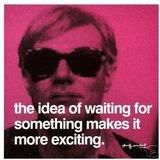
ANTICIPATION

PhotobucketI suppose Andy Warhol was right on.

My mother called me today, to say that CNN was airing short profiles of autistic people and their families. She was happy to report that most were positive stories, and they were showing autistic adults as well. So, I turned it on and saw this great story. I wonder if Jenny was tuned in to CNN today?

Anyway, at lunch this weekend, discussion turned to the "Naughty Auties" special (which I missed) and then Autism: The Musical. I've gotten quite a few phone calls and emails in the last few days, friends and family alerting me to different news specials I may want to watch.
Teletubby Metal!! Earlier today, my older daughter tells me about the Autism-Teletubbies commercial she saw when her sister was watching cartoons. This was comical, she relayed the ad practically verbatim. I joked, "so, are the Teletubbies coming to live with us?" My very serious eldest, unamused by my question, says, "No. But, they did give a website, www.autismspeaks or www.speaksautism or something like that." Great.

So all of this in the last couple of days, coupled with the commercials promoting World Autism Awareness Day, and the many fund raisers going on during Autism Awareness Month, I have this feeling of anticipation. All of these groups and news organizations have hyped tomorrow so much, that I am anxious and excited for it. I realize that April 3rd will be no different than today. It's not like some momentous event will occur tomorrow, changing all our lives. But still, I feel I will have a hard time sleeping tonight. My mind will surely wander--what will be aired? What messages will get across? How many times will I cringe? There's a part of me that is very hopeful. Maybe, just maybe, some really good perspectives will be shown. It's possible that good programs for children and adult autistics will be born out of the information presented tomorrow.

Thus far, the overriding theme seems to be about adult programs. I hope this carries over for tomorrow, along with financial planning (aka don't throw blow through all your money and go into debt while your kids are still in the single digits, what will you do for them in their teen and adult years??). That would be a welcome and refreshing change for autism awareness. I suppose I will watch quite a bit of TV tomorrow, my DVR is already set to record a few programs. I suppose I should hit the grocery store for some snacks just for this occasion (sarcasm).

You can visit CNN and see what they've already aired, and what is on the schedule for tomorrow. Better get your popcorn...

3/26/08

Autism: The Musical

autismI watched it tonight on HBO. Well, actually I just got done watching it on my DVR. If not for that, I'd never catch a show on television (other than what my daughters choose!). Just before the "opening night" in the film, my daughter started screaming. I went to her room, she was screaming over something I wasn't able to make sense of. I picked her up and she settled down. I brought her into the living room, continued watching Autism: The Musical. She rested beside me, and fell back asleep. Just as the movie was ending, she says, "that was good movie." I guess she heard the audience applaud, and figured it must be good! She then went on to talk about a "pop" that "boke" (she unexpectedly got to the tootsie part of a tootsie pop the other day, it quite disturbed her!). This morning, she woke up screaming over her trike that needs some repairs. I'm always amazed at how much is going through her mind, at all times. I digress, back to the film (little one is now back to sleep in her room--for now)

I loved a lot about the film, there were some parent's views I disagreed with (what else is new). I'm at the point where I am well aware that I won't agree with all the people all the time. I've even reached a stage where I don't care so much what someone else's views are, so long as their concerns and goals are in tune with mine. I am more than willing to work with someone who blames vaccines for their child's autism, IF we are working to get say, a vocational program for adult autistics. We can all have our various beliefs, so long as we are moving forward, with our child's future being the utmost concern. I was able to watch this film, and appreciate it as a whole--even with the few sound bites I'd prefer not be a part of it. All in all, I felt it was an upbeat movie, one that celebrated autism (in its many forms!). It was wonderful to see so much of the spectrum depicted--verbal and nonverbal, asperger's and classic autism, boys and girls, many snapshots of autism.

I also liked that a recurring theme was the future for our children, what opportunities and services they may (or may not) have available to them. Hopefully, it can serve as a stepping stone for more of us to come together, to change our children's futures. There were a few absolutely wonderful moments in the movie, and I appreciated the rawness of the parent's emotions (without being dark and disturbing ala that other Autism "documentary"). I applaud the children and their families, who essentially went where others had never dared gone before. I have deep respect for Elaine Hall, who with humor and bravery followed through on her dream. Honestly--who would believe that a single mom could pull together a group of children (did I mention they are autistic?), and in six months have them perform in a musical?

According to their website, The Miracle Project (which will at some point have information on nutrition and education, something I may be weary of, we shall see) is planning on branching out to different cities. Right now, you can buy various packages (script, music, etc.) to put on your own "Autism: The Musical." I would be delighted to see such a program available to my daughter in the years to come. I think other projects involving art and music would also be wonderful as well; they could prove to be very beneficial to autistic teens. I am going to bed tonight, feeling a bit more positive about the future of autistics. If one person can create a program like The Miracle Project, and make such an impact--what can the rest of us do?

3/24/08

Seriously, Jenny

PhotobucketI just caught Jenny McCarthy's interview on E!'s Chelsea Lately show. Here is the link (bad language warning). Really now, it is frightening who we have speaking to the public about autism and supposedly representing "us."

She talks about how she asked Mormons to come pray for her "sick" son (and how when your child is sick you'll decapitate small animals, hmmm...). I wonder if this is before or after she discovered her child was a Crystal? To say that Ms. McCarthy was desperate for some type of hope for her and her son, is an understatement. I've never seen someone speak so frantically over their child's autism. No wonder she hopped onto the DAN bandwagon, and now is so 'into' TACA & Generation Rescue. One can only speculate what she may discover next, what group she'll become immersed in. Perhaps Dr. Carley will win her over?

We're not all screaming "HELP US!" At least we're not looking for the "help" you have been shoving down our throats for months. The help I want, is knowing that my school district has the proper resources and is giving my child all she needs to achieve her potential. The help I need is programs for my child and many others as they reach adulthood. I need help with transition from the school system, will my child have the opportunity to attend college? Will she be able to live independently, will there be housing options available to her? Is there vocational training available, and who will hire her? Will she be able to attain medical care, psychological services, etc. from reputable physicians? How will the world view an autistic adult in 10-15 years? If changes are not made, how many autistic children growing up today will be homeless in their 20's, 30's, or 40's?

She goes on to give the number to the White House, asking viewers to call and ask for the resignation of Julie Gerberding, CDC Director. Chelsea suggests telling the White House, "Julie Gerberding suck it hard!" and Jenny adds, "I was going to say aka the Devil." Nice. Later on, Jenny says she hopes "we create a major s**tstorm," over this issue. Lovely, now that's classy. I'm so glad that the public will look to Jenny and feel she represents all autism moms. I can only imagine what the media coverage will look like on that weekend in June when Jenny and her fellow Generation Rescue drones will descend upon the CDC. I wonder if their posters will have signs with the above mentioned quotes? Should be quite a circus.

The interview ends with Jenny stating that we (us autism moms) live in a kind of hell. Not me, no way, not by a long shot. Jenny, you want to know what hell feels like? For us, it was watching our child lay lifeless in the PICU. She had tubes coming and going, tests round the clock, she was essentially in a coma and no one knew why. We thought we were going to lose her. Jenny, that is hell, fearing that your child is going to die and you can do absolutely nothing about it, except pray every minute. Get some perspective. Life with autism is not this nightmare you are selling to whoever will listen to you. It's amazing that celebrities feel they can actually relate to moms in regular America. None of us can just go do a photo shoot to make some more money to cover our child's therapy. We don't have access to the press to speak up about our concerns and get funds raised toward what's really needed. You simply can't relate to us, and again, "we" don't live in a "kind of hell." And, besides, with your son "recovered," what exactly are you whining about?

In the very end, they both state that the government has said that vaccines can cause autism, as just decided in a recent court case. Really? Which court case was that, did I miss it?

3/18/08

The Money Trail...

Photobucket
Where will all the money raised by Toys R Us go?


Autism Speaks and Toys R Us have had a relationship for over a year now. This year, it appears, they are going all out. Which, like I said earlier this week, one can only wonder what all will come in April. In addition to the in-store donations, "the world's greatest toy store" is also accepting them online. At the time I write this, $539,448 has been raised (which, is up over $20,000 from the $519,229 they were at when I began drafting this last night). They are raking in, on average, more than $30,000 a day. Given that, they very easily could raise over 2 million dollars. This campaign began on March 2nd and continues until May 2nd. We all know where this money will go to: research, research, research--the Autism Speaks mantra. Of course, some money will go toward entertainment, catering, private jets, salaries to people like Allison Tepper Singer, and who knows--maybe an Autism Everyday Part II? Read about it on the Autism Speaks' website (their 2006 report, I can't wait to read 2007's). As Lisa Jo Rudy writes,

"Personally, I'm encouraged to see community grants and insurance issues are making it to the front page of the Autism Speaks website - though I'd love to see the organization create a division dedicated to living - and thriving - with autism."
We shall see if Autism Speaks ever gets a clue and decides to actually support autistic individuals. Then perhaps so many of us wouldn't cringe when we checkout at the Toys R Us, turn on Oprah, or see that the Sundance Channel is premiering "Autism Everyday" on April 2nd. I won't hold my breath though. Here's how they prioritize those living with autism, as per the "goals" statement from their website:

We are dedicated to funding global biomedical research into the causes, prevention, treatments, and cure for autism; to raising public awareness about autism and its effects on individuals, families, and society; and to bringing hope to all who deal with the hardships of this disorder. We are committed to raising the funds necessary to support these goals.

Notice the order:
1. make LOADS of money for research into causes, prevention, treatments, and cure
2. raise public awareness (via depressing "documentaries" apparently)
3.
and, if and when we get around to it, "bring hope to all who deal with the hardships of this disorder"

They never actually say they want to help autistics, or create programs for teens and young adults, or support job-training, independent living, etc. for adult autistics. Bringing hope is a rather broad term. What hope exactly are they bringing? That one day a "cure" might exist, or that prenatal screening will be available? Once again, painting the bleak picture of the "hardships" we live with is getting rather old by now. Now compare Autism Speaks' goals with The National Down Syndrome Society's values and The National Autistic Society's vision and mission statements. Keep in mind, also, that the NDSS began in 1979 and the NAS has been around for over 35 years.

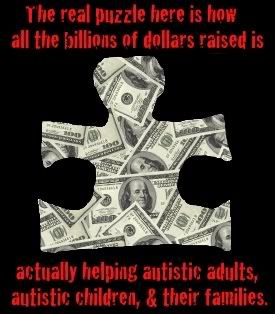
I'm not sure what "puzzle" Autism Speaks wants the public to think they are concerned with solving. To those of us who take personal offense by their messages and continue to receive zero support from them, we understand what this "puzzle" is. They promote the idea that if your life is touched by autism, you are miserable, your child has been "stolen," you are in debt, your marriage is falling apart (if it hasn't ended horribly already), and your life is one long nightmare. When you combine those viewpoints, the statements made by the "leaders" of Autism Speaks, read over what research their money is going toward, and see their tax return, it becomes clear. The puzzle they are struggling to solve is how to end any future generations of autistics. They want nothing more than to annihilate autism, all together, all of it--all future autistics, and frankly nothing else. They've even convinced politicians like Hillary Clinton to make public statements about working to "prevent and cure anything along the Autism spectrum." As for the autistics living (and thriving!) today, well, let's just disregard them altogether.

Autism Speaks could learn a lot from The National Down Syndrome Society and The National Autistic Society. The day that Autism Speaks actually reaches out to Autistics, and makes supporting those individuals a priority, then perhaps I would like to "help autism" at the check-out line.
Photobucket

3/2/08

Autism In The Marketplace

My husband sent this article to me, it's on Newsday.com. It's an interesting piece, and I'm fairly certain this is the first one of its kind I've come across. It discusses adult autistics (yes, Jenny, they really do exist), dealing with finances, living independently, and the difficult issue of legal guardianship. The story is from the parent's perspective. It deals mainly with adult autistics who would seem to need little, if any, services. Yet, they still run into major issues with finances and have difficulty with other day to day interactions.

The story closely mirrors the ones I hear from families whose child is considered by the school to be "high functioning" and is dropped from special-ed or services. These children skim by, many drop-out or have major issues, especially in high school. If you can do fairly well with school assignments, sit still in class, they presume one doesn't need any extra help. They pay no attention to how one relates to others on the playground or cafeteria. If grades slip, its often blamed on the child losing interest or not paying attention. It often takes quite a fight to get services for the child, and prove to the school that help is needed. It appears, this same mind-set holds for when these children become adults.

While there are many adult autistics who are able to hold jobs and live independently, or others who are able to do so thanks to support services and help from their family, there are plenty that are slipping through the cracks. How many are homeless or institutionalized? What is the crime (against them), murder, or suicide rates? What number of them suffer with psychological issues, alcoholism, or drug addiction? These are areas that few have looked into, most would rather look the other way. It's not their problem right? And, now that we have "treatment" and someday soon a "cure," why do we need to concern ourselves with that right? It will be their problem, not mine. "I've got my kid on 50 pills a day plus some injections, a hyperbaric chamber, sauna, chelation, and more, I don't need to worry about him 'having autism' when he's 18, right?"

I realize "early intervention" and all is important, but to be honest, I worry more about what comes after age 18 or 21. My daughter did receive early intervention from the state, as well as private therapy, and we did a lot of "play therapy" at home. It wasn't really therapy we did at home, so much as it was we found new ways of playing and engaging our baby/toddler. We had to learn a different way to play with her, its been that way since infancy. My child thinks and acts differently, therefore, we have learned new and different ways of interacting with her. Basically, I feel if you have an open mind and a kind heart, you can help your child in those early years. The help is there if you seek it, and there's plenty you can do at home. Just be open to new ideas, be patient, and compassionate.

It's what will happen once my child turns 18 or 21, when the school will no longer assist us, that concerns me. I'm not going to assume her level of independence, at this point. We will support her in every way, and she will continue to make us proud--where ever the road leads her. We of course have some concerns over her physical and neurological health, but are hopeful those will improve with time. Putting those aside and solely thinking in terms of autism (along with her sensory and psychological issues), and her future--every aspect of what will happen in adulthood is concerning to me. If she is able to live independently, will services be available to assist her if need be? Will college be a feasible option? Will she be able to find a job, are there vocational programs? What would happen in an emergency, or if she had to deal with first-responders? Will she be able to find proper medical care and pharmaceutical assistance? What resources will be available?

This story highlights some of those concerns. I think whether your child will continue to reside at home or live independently in adulthood, there are a mountain of questions, and very few answers. We all know the majority of money that autism charities receive is going toward research, studies, media, etc. Very little goes to actually benefiting autistic children and their families, almost nothing goes toward autistic adults. Since the pro-cure groups, at least some of them, are now admitting that our autistic children are becoming autistic adults, perhaps there will be more stories on this. Hopefully, as their children enter adulthood, they'll realize the need and use their media savvy and celebrity friends to get more programs and more money flowing in to benefit adult autistics.


FYI: The link to the article is found in the title, if that doesn't work:
http://mobile.newsday.com/news.jsp?key=152152&rc=bu&p=1

2/26/08

The NYU Child Study Center Town Hall Meeting...hmmph

PhotobucketWell, I was hopeful. I even gave up a much-needed manicure for it. I have 3 hours a day to myself, for myself, where I have nothing to do but whatever the heck I choose. I felt strongly that today I needed to stay here at my laptop and see what this "Town Hall Meeting" was all about.

I will say I'm glad NYU Child Study Center actually did this, and I'm glad they are reaching out, it appears, to further this topic of public awareness (in, hopefully, a respectable manner). But, it seemed to me that while some good questions were asked, there weren't any answers. In fact, most responses felt more like pre-written soundbites. I don't know, maybe it was just me. The forum itself was a little flaky at times, it had a few kinks in it. My question was posted by "Anonymous" instead of the user name, S.L., I had chosen. Here it is:

What is being done for teens with autism etc., with regard to preparing them for adulthood, independent living, etc? Do you currently have programs in place to help these children (and their parents) ease into adulthood? It's great how far we've come with early intervention and the school system, unfortunately, at 18 or 21 , these individuals are essentially deserted, and often forgotten about.

And, the response:

Federal law mandates that at 15 every child classified with a disability begins a who are graduating from high school. Adult agenices are begining to understand the specific needs of young adults on the autism spectrum and plan more specific job support for them but we are just in the infancy of understanding how to truly integrate individuals on the autism spectrum into the workforce. in preparation for adulthood teens need to have a variety of work experiences, improve their social skills development and learn how to advocate for their own needs in the community. Professionals and parents need to ensure that these early steps are taken in preparation for adult life.
But what are you doing? What is NYU doing? From that "answer" I can only assume they do not have any such programs in place. The overall theme was "early diagnosis, intervention" and it appears they are holding onto that as being all that's needed. My daughter had early intervention (from before age 1 for developmental delays!), she's been followed by a neurologist from before she was a year old. Check, check. And now we wrangle our way through the school district, and hope they are helping my child in the best way possible.

I am still very concerned for her future. What will her options be after high school? What happens when her father and I are no longer around? What is waiting for her? Right now, the answer is nothing. I feel as if I'm running a marathon (unfortunately on a treadmill, as I feel I'm going nowhere) to find something for my child and all the others like her, who one day in the future will be 18. That day gets closer and closer, with only a bunch of talk about early identification and intervention, second to that is "cure."

Photobucket