STOP FOR A MOMENT. TAKE A DEEP BREATH & EXHALE. IT'S AUTISM--NOT THE END OF THE WORLD.
Having an autistic child is not the end of the world--far from it. It is my hope that through this blog, at least a handful of people will get to understand that. My child is amazing, she brings us tremendous joy. We have good days & bad days, but we CHOOSE to focus on the good. Our belief is that by loving our daughter, giving her the most comfortable environment we can, and by most of all accepting her differences, she will continue to blossom--in her OWN way.
My apologies for having fallen off the map here. I've had some personal issues going on, and finding the time and energy, let alone the thought process, to blog has been nearly impossible. It is my hope to be back up and running (well, writing!) at some point down the road. I am going to make a true attempt at reading my fellow blogger's pieces (as I've not done so lately and I miss reading all you have to say!).
I want to wish everyone a Happy & Healthy New Year. It is my hope that 2009 brings about great change for autistics, change that leads to acceptance and services and open minds.
Tomorrow is Katie McCarron's birthday. This loving and cherished girl would have been 5 years old. My own words simply wouldn't be adequate to celebrate Katie's life, so I shall honor her with the words of her loving Father and Grandfather. Each time I write an entry on this blog, I think of Katie. Every time someone asks me why I blog and why I am so passionate about these issues, I think of my own sweet daughter and also of Katie. So many of us have been eternally affected by this adorable little girl, taken from this world far too early.
From Katie's Grandfather, Mike McCarron on AutismVox:
I would like to say something about Katie. Some newspapers have reported that this was done to end Katie’s pain; let me assure you that “Katie was not in pain”. She was a beautiful, precious and happy little girl. Each day she was showered with love and returned that love with hugs, kisses and laughter. Katie loved music; she would fill in some of the words in children’s songs as my wife would sing along with the CD that would be playing, their own version of “karaoke” . She liked to dance, she loved to do the “hooky poky”. She loved being in among flowers and tall grass. She would say “I like grass”. She enjoyed the zoo and because of all of the drills and flashcards she could identify the animals. Which I thought was pretty amazing for such a young child. She was also the only little child in her non-autistic play group that could identify an octagon. My wife and son had a party for her the day they heard that from the teacher.
She enjoyed having her grandmother dress her in new little outfits and dresses, and I think this is important. We have four grand-daughters, my wife loves to buy them frilly little dresses. When my wife went into a store she would never ask for three normal dresses and one autistic dress. I think we need to be very sensitive to the special needs of these children but at the same time not be oblivious to the numerous typical traits that are also developing. Katie was first and foremost a little girl, she enjoyed people making a big fuss over how pretty she looked. My wife would take her to the beauty shop to have her hair trimmed. Katie enjoyed going to the mall and looking in all of the stores and windows. These are female things.
She went to special schools everyday, the staff at those schools cherished her. I can not say enough for the staff at Mariposa. They were so very much more than professional therapists, they adopted her and loved her deeply. Katie was so lucky to be with them everyday.
There is also another young lady in North Carolina who worked with Katie during non-school hours. The bond that she had with Katie was unbelievably deep. I am amazed that a single Mom working to raise a son by herself could find so much extra love. Maybe love is one of those special resources, the more you give the more is given back.
Katie loved the park, the swings, the slides and being outside. She played with her dolls and toys; she loved “teletubbies” and brought joy to all of those that had actual contact with her. Yes, she was autistic. Developmentally she was behind other children. But her small victories would create unbelievable joy for those who loved her. I can not describe the ecstasy of having her little arms around my neck or of watching her and my son roll around on the floor playing in shear happiness.
Each day I ask the Lord if I could take her place, and perhaps He could return Katie to the loving arms of my son and my wife. So far that prayer has not been granted. But in the meantime I can assure you that no one will describe her murder as “understandable” or devalue her in anyway without my personal challenge to them and the organizations they represent.
I must apologize for the length of this post, please know that I keep each of you in my prayers.
"If the measure of a person's life could be quantified by the number of people that loved them, then Katie, in her brief 3½ years, achieved well beyond all of us," Paul McCarron said... "I ask all parents, and especially those of children with disabilities, to always love your children and be proud of them," Paul McCarron wrote in his statement. "Cherish every moment you have with them. Love, patience and tender efforts are the best therapies."
Kev has also written ever so eloquently here, "Dear Katie."
We remember, with a smile and prayer, beautiful Katie.
I must add--as you may have read previously in my blog--I agree somewhat with Mr. Savage to the point of over-diagnosis. I've even contemplated if Jenny McCarthy's son possibly has other diagnoses, and not autism. I wonder if a lot of the so-called "recovered" children were never really autistic to begin with. I have seen allergies wrongly labeled as ADHD and behavioral problems. This does happen. There are also parents, a very small amount, who essentially "shop" around for an autism diagnosis. I would feel comfortable saying there probably are children out there labeled as autistic, who in fact are not. But, surely, no one would even ponder that 99% or anywhere near that number, of those said to have autism really don't (and furthermore, that they are brats).
I will also say that I feel we have become a society who wants only instant gratification, and that includes forcing pills down your child's throat so they behave more appropriately. To put a child on medications (especially say a 2 or 3 year old) first, without attempting therapy and other help, should be strongly discouraged. And, to medicate a child just so they are more docile, to prevent stimming (which is not self-injury), and so forth (and not because the child has severe issues, is harming themselves, severe mood swings, etc.) really should not be an option. All too often, autistic individuals are drugged to near-coma states, locked up, and forgotten about. This should not be tolerated.
I also feel for Mr. Savage, apparently his brother died in a NY mental hospital. That has to be awful, to go through that first-hand. I don't know much of his experience, other than a brief statement I found. But agreeing with Mr. Savage on his views regarding medications for children and sympathizing with him over his brother, does not excuse the ignorant and inappropriate statements he made.
From several sides, his comments are offensive--and very flawed. Let's start with this claim that in "99 percent of the cases, it's a brat who hasn't been told to cut the act out. That's what autism is..."
Really? That has got to be one of the most ignorant statements I've heard with regard to autism (and trust me, I've heard plenty). So, Mr. Savage, you mean to tell me that only 1% of the children who are diagnosed with autism--who attend special programs, therapy, etc. for their autism--only 1% are actually autistic? Based on those odds, it's very likely that in his mind, my daughter or anyone of her classmates must not have autism, or the kids who attend the same therapy center, most if not all, are not autistic. Right, that makes perfect sense Mr. Savage.
Then there's the fact that he views autism as a "fraud, a racket." I'd love to hear how exactly he concluded this. Is my daughter acting, putting on a show? Are we as a family gaining something from some sort of sham, from "faking" autism? Exactly what kind of "racket" do we have going on? I'd love some explanation--but again, these are some of the most ignorant and nonsensical statements about autism I've ever heard.
He spirals even further downward, placing blame on the fathers (which is an interesting twist, typically it's us moms who get the blame from misguided people). Apparently, Mr. Savage also is unaware of girls like mine, who are also autistic. His rant centers around the idea that boys are not being yelled out by their fathers, and that's why they are being diagnosed with autism. Fathers, according to Savage, should tell their sons:
"Don't act like a moron. You'll get nowhere in life. Stop acting like a putz. Straighten up. Act like a man. Don't sit there crying and screaming, idiot."
This was especially disturbing to me. Not too long ago, autistic children were called many horrible names by the medical community. Today, sadly, there are too many in society who still refer to our children with vicious insults. The words "putz" and "moron" (and "dummy" which Mr. Savage also said later on) were bad enough, but "idiot" really enraged me. Years ago, my child would be labeled an "idiot savant." She has an extremely high IQ, uneven skill sets (splinter skills), yet her social, adaptive, and communicative skills are rated in the very low to low range.
I never thought much about the word "idiot," it easily rolls of the tongue of most people. But in the last few years, it's had new meaning to me. Our neurologist first said "idiot savant" following our child's first IQ test, explaining how a person could have a genius IQ along with developmental delays, etc. We were utterly perplexed by this concept. Our neurologist said "the outdated term you may be familiar with is 'idiot savant'." I know how society used to treat "idiots" and "idiot savants." I also know how history has a way of repeating itself. This is not a word I would ever use in reference to autism or autistic individuals. Shame on you, Mr. Savage!
I would invite Mr. Savage to come stay with our family for a week, or even a day. Then perhaps he could enlighten me on how we were benefiting from this autism "racket," and how my child was really just a "brat." Maybe he could show my husband how better to berate my child, so she wouldn't act the way she does. I wonder what Mr. Savage would say to the neurologist, psychologist, developmental specialists, pediatrician, special ed teacher and para, and multiple therapists who see my child, have diagnosed her, and so on. Are they all in on this sham too? I am curious to hear this man's recommendations.
Savage's comments are, at best, a big fat waste of breath. I considered not even writing about them. They are ridiculous, and not really worth my time. However, Mr. Savage has a huge following (upwards of 10 million listeners) and therefore his words can alter millions of people's views on autism. That can be dangerous. The last thing we (autism families, autistic individuals, and society as a whole) needs is more stigmatizing, stereotyping, and mocking.
Just checking in to let you know I am on vacation. It's a long one this year, just about 3 weeks. We've traveled quite a bit (plenty of stories to write about in the following weeks!), visited with family & old friends, and, as always, hopefully are changing others' ideas of Autism every day. I have lots to write when I get back. For now, it's too hectic for me to find time to blog. Which is a good thing, it means we are having fun. Thanks for stopping by.
If this is your first visit to my blog, hello and welcome. Here are some of my personal favorite posts:
I've written extensively on Jenny McCarthy as well: Is Jenny Really An Autism Mom? Yes...she still is very much into the whole Indigo & Crystal thing, plus it seems she gets her vaccine advice from an entity known as Kryon, and there's more I've compiled here.
For the next week, I most likely will not be blogging. But, check back after 7/24 for new entries.
I'm not entirely sure what this presentation will turn out like, what the focus will be, and so on. I thought I'd send this along though, hopefully we can ensure that our voices can be heard (once again).
ABC News Seeks Submissions for iCaught: OnCall+ Autism Thursday, July 3, 2008 By: Carin Yavorcik
Share your stories via video
ABC News is presenting an opportunity for you to share your personal experiences as part of a special hour on Good Morning America Now: "OnCall+ Autism." You can also send a question about autism that may be answered by a top medical expert in the field.
ABC News is looking for video submissions on the following topics: 1) Your thoughts on living with autism or with loved ones with autism 2) Any questions you might have on autism to be answered by our medical experts
Most digital cameras now have a video function that allows the user to record 30-second to 1-minute videos. Once recorded, you can upload the video to your computer the same way you'd view digital snapshots. ABC News is specifically requesting 15- to 45-second videos.
How to submit:
1) Via cell phone: Record a 15- to 45-second clip and email it to: icaught@abcnews.go.com
2) Via the web Click on the red "RESPOND NOW" button
Videos submitted by the end of July may appear on ABC News NOW!
I wrote about the death of Gabriel Poirier the other day, but this article was emailed to me, and I wanted to post it here. I wanted to write more about Gabriel, for one because many (like myself) had not heard about his death until this week (he died in April). Also, and most importantly, because I don't want any of us to forget him--a nine year old boy, innocent, simply attending school. We have to remember Gabriel, and his parents. Please visit this article by Graeme Hamilton at the National Post.
MONTREAL - After nine-year-old Gabriel Poirier was discovered lifeless in his classroom last April 17, his parents were told their autistic son had stopped breathing after hiding under a heavy therapeutic blanket.
Now a coroner has revealed that Gabriel's teachers had tightly wrapped him in the buckwheat-stuffed blanket, leaving only the tips of his ears sticking out, as punishment when he became disruptive. They left him unsupervised in a corner for 20 minutes, returning when a timer sounded.
Gabriel was unconscious and blue in the face. He was rushed to hospital, where he died the following night surrounded by his family.
It's pointed out in the article that weighted blankets can have therapeutic benefits. Our eldest happens to use one, it helps her sleep issues. Our youngest has used weighted lap pads, backpacks, and utensils. She also enjoys being "squished" by two pillows, bean bag chairs, etc. It is very calming. But, as Gabriel's father points out, what this school did to his son was not therapy, it was abuse.
"He was only 53 pounds, he was so small," Gilles Poirier, the boy's father said at a news conference yesterday. "How can they wrap him up like that in a 40-pound blanket? How can this treatment be tolerated?"
Not only was he wrapped four times by such heavy weight, but his entire face was covered, and obviously, he was trapped. Even more disheartening were the lies the school told the media and to Gabriel's parents. More from the family's lawyer, Jean-Pierre Menard:
Mr. Menard said the parents were surprised to learn Gabriel had been placed in the blanket as a punishment. The school board had initially said it was a natural death and that Gabriel had gone under the blanket on his own.
"The principal said they found Gabriel under the blanket and he wasn't breathing. The parents thought that something had happened while he was sleeping and that was how he died," Mr. Menard said. He said the school board later told the media that Gabriel had hidden under the blanket.
How a school could lie about Gabriel's death is beyond me. I hope they will be held accountable, and that real change is made regarding restraints. The article ends with this:
Mr. Poirier said he cannot understand why his child was placed in a restraint. "He was a very gentle boy," he said. "Sometimes he was loud, but he was never aggressive or violent. I just don't understand how this happened," he said, tears streaming down his face.
We can't sit idly by while such tragedies occur. My heart goes out to the Poirier family. I have not seen a picture of Gabriel, but there is a picture of his parents here--I feel images are so crucial to making an impact. We have to vow to never forget Gabriel.
This is a new story, yet the theme is nothing short of disgustingly familiar. Another autistic child being kicked out, this time from an airplane. We've seen this play out time and time again, with children being booted from school, church, the movies, and Boy Scouts. Where is all the Autism Awareness?
Here we are, trying to live our lives with our children. And all too often, the treatment we receive from those in society ranges from rude to cruel. The stares, snickers, and whispers are one thing. But lately, it seems the job of parenting an autistic child and that of simply being an autistic person has become increasingly more difficult. The message that we, and our children, are an inconvenience and need not be tolerated is becoming quite clear. There was a time when it was thought community was where you turned to when you needed assistance. The idea of reaching out--whether to your church, your school, or other community groups, seems more difficult for autistics each day.
Now, I will say, I look at things on both sides. In fact, prior to my experiences with my youngest, I may have agreed with the airline's position. I may have believed that kicking this mother and child off the flight was the only option. And to any who feel this way, I say walk a mile in our shoes. I have seen time and time again, the intolerance toward autistic people, and people with disabilities in general, is shameful. I am not surprised that this flight crew was forceful and abrupt, and that they did not attempt to work with this mom and her son. It was only a few weeks ago, that AutismVox wrote about an incident in the security line with her son. What more is needed, for society to become tolerant of our children? The sad truth is, most would prefer we keep our kids away.
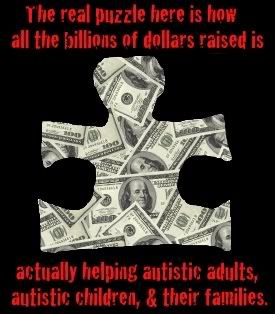
With all this "autism awareness" everywhere, I ask you this: where is all the understanding? Does it matter that someone knows what autism is, or the figures 1 in 150, or that Jenny McCarthy"recovered"her son? No, obviously it doesn't. It's gotten us nowhere. Proper care is still very limited, we are still lacking in options for teen and adult autistics, services are frustratingly limited. Autistic children and adults are being abused and killed, as I wrote about recently. Autistic individuals, and their families, are discriminated against. All of the money raised in the name of "autism awareness," all the signs at Toys R Us, the pretzels, the CNN coverage...and where has that gotten any of us?
I have to tip my hat to society--if it weren't for its' continued intolerance of autistics, we'd never hear "autism" uttered so frequently by every news agency in this country. The last several weeks have brought on a barrage of stories about autistic individuals. Some have been more positive, sadly, most have been about autistic children being excluded (or much worse).
On Monday, two and half year old Jarett Farrell and his mother were on an American Eagle flight, on their way to visit family in New Jersey. Jarett, who is autistic, was having a tough time and was upset. It it should also be pointed out--many young children have difficulty on an airplane.
His mother says she was doing all she could to calm the autistic boy, but got no sympathy from the flight crew.
"If they just would have been a little more understanding I think that none of this would have been a problem," Mother, Janice Farrell said.
Instead, it only got worse:
"She kept coming over and tugging his seatbelt to make it tighter, 'This has to stay tight'. And then he was wiggling around and trying to get out of his seatbelt. And she kept coming over and reprimanding him and yelling at him," Farrell said.
One of the pilots came back to the cabin with a stern warning and Farrell says the frustration level escalated.
The pilot turned the plane around, and the mom and child were "escorted" off the flight. And, just to ensure no one would be confused about what was going on:
"The pilot made an announcement that there was a woman and her child on the plane and the child is uncontrollable. And at that point I just broke down," Farrell said.
We are taking a family vacation this summer. After much discussion, we decided to travel by car. This decision will take much longer, be more costly, and we still are not certain how either of our children will handle it. However, when we thought about flying, and the many delays and cancellations my husband has faced, it seemed we were better off driving. We'd also heard of at least one other child whose flight made an emergency landing, because she was crying. Friends of ours recently had an experience where a flight attendant placed her hands down on their son's (who is not yet 3) legs, trying to force him to sit in his seat (they were about to land, and he wanted to sit in his mother's lap). Other passengers were outraged, and made complaints over this crew member's behavior.
We thought long and hard about our daughter, at the airport, on the plane, and so on. What if our flight was delayed? How would she handle long security lines (this story in particular was concerning)? What if we were stuck on the tarmac? What would happen if she had a meltdown mid-air? All of those questions and concerns made us lean toward driving.
Yes, our decision to drive (which we made almost 2 months ago) was our own. I feel better knowing we will be in our familiar car, and not have to deal with strangers and others who may interfere or do otherwise should our child have a meltdown. Knowing how the airline companies have handled other situations, I was honestly anxious thinking of flying with my daughter.
I have to wonder though--if society (including airline crews and airport staff) was more tolerant and these stories weren't so common, would I still feel the same?
I found this news clip about Jennifer Lopez's performance at P.S. 37 in Staten Island. I wanted to share, it was a joy to see the kids dancing, and being so happy.
"Autism is a way of being. It is pervasive; it colors every experience, every sensation, perception, thought, emotion, and encounter, every aspect of existence. It is not possible to separate the autism from the person."
- Jim Sinclair
The views & opinions expressed on this blog are just that: views and opinions of the author. I do not, nor have I ever, worked for a drug company or the government. I am not part of any vast conspiracy. I do not receive any income from this blog, I do not have any income whatsoever. I am simply passionate about my child and her future, and about the rights legally afforded to autistic individuals.








 This Way of Life









 "Autism is a way of being. It is pervasive; it colors every experience, every sensation, perception, thought, emotion, and encounter, every aspect of existence. It is not possible to separate the autism from the person."
- Jim Sinclair
"Autism is a way of being. It is pervasive; it colors every experience, every sensation, perception, thought, emotion, and encounter, every aspect of existence. It is not possible to separate the autism from the person."
- Jim Sinclair